
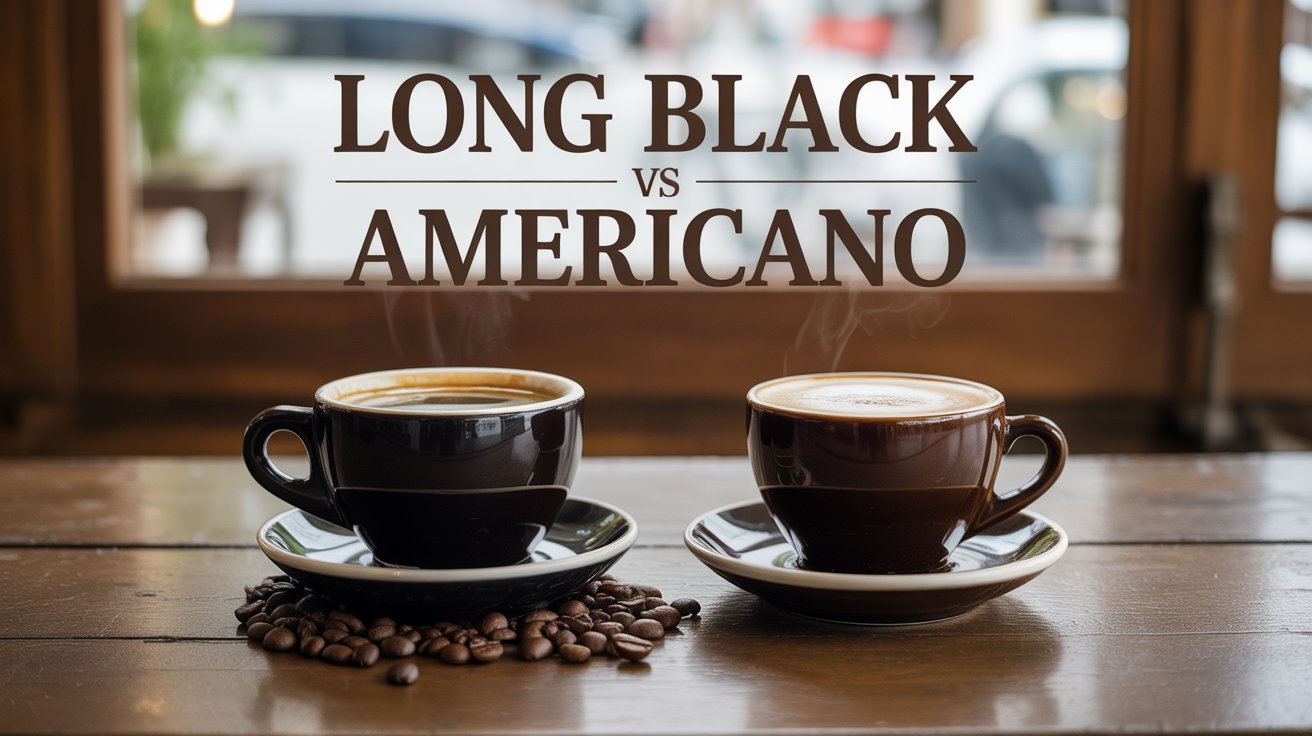
If you’ve ever ordered coffee and wondered why a Long Black tastes bold while an Americano feels smoother, you’re not alone.
And yes — the real difference goes far beyond “just adding water.”
Most coffee drinkers confuse these two drinks because cafés rarely explain them well. I made the same mistake years ago — until a barista showed me how a tiny shift in pouring order completely changes flavor, aroma, and crema.
Here’s the good news: once you know the core differences in the Long Black vs Americano debate, you’ll never second-guess your order again.
This guide breaks it down clearly, quickly, and with the kind of straight-to-the-point insights you wish every café chalkboard had.
Let’s dive in.
What Are These Drinks? Origins & Definitions
What Is a Long Black?
Definition (Espresso Over Hot Water)
A Long Black is a concentrated, crema-rich coffee made by pouring espresso over hot water.
This simple order-of-operations shift is what separates it from an Americano. It keeps the crema intact and preserves the espresso’s aromatic oils — the part that gives specialty coffee its complexity.
This definition aligns with how Wikipedia, 1Zpresso, and most Australian and New Zealand baristas describe the drink.
Origins (Australia & New Zealand)
The Long Black traces its roots to Australia and New Zealand, where café culture has long prioritized crema quality and espresso-forward flavor.
You’ll still see it on every specialty menu from Melbourne’s laneway cafés to Wellington’s espresso bars — a cultural staple recognized in both Wikipedia’s coffee taxonomy and modern barista training.
Experience & Depth
If you’ve ever ordered a Long Black in Sydney, you know the ritual: the barista heats a small cup of water, pulls a tight double shot, then floats the espresso on top.
The crema hits your nose first — thick, golden, slightly sweet. That sensory pop is why the drink exists.
What Is an Americano?
Definition (Espresso + Hot Water)
An Americano is made by adding hot water to pulled espresso.
This dilutes the espresso more evenly and produces a smoother, more “drip-coffee-like” experience.
It’s the definition favored by Wikipedia, the Specialty Coffee Association, and most barista training guides.
Historical Origin (WWII American Soldiers in Italy)
The story goes like this: during WWII, American soldiers stationed in Italy found traditional espresso too strong.
They asked for hot water to be added, creating a drink that resembled the brewed coffee they were used to.
Tasting Table and multiple coffee historians reference this as the widely accepted origin.
Experience & Depth
Order an Americano in Rome today and you’ll notice it comes in a larger cup, lighter in body, and with a thinner crema layer — if any at all.
It’s designed for sipping, not analyzing.
Brewing Mechanics: How They’re Made
Long Black: Water First, Espresso Second → Preserves Crema
A Long Black always starts with hot water in the cup.
The barista then pulls a fresh espresso (usually a double shot) and pours it gently over the water.
This “espresso-on-water” method:
preserves crema
reduces agitation
intensifies aroma
keeps the flavor concentrated
I’ve tested both methods at home on a Breville/Sage machine — espresso-over-water wins every time. The crema stays thick instead of dissolving into foam.
Americano: Espresso First, Water Second → More Mixing, Less Crema
The Americano flips the script.
You pull espresso first, then add hot water on top.
This naturally:
breaks the crema
dilutes the espresso more evenly
creates a lighter, smoother body
Tasting Table notes that this technique is why Americanos taste more like a long, mellow coffee than an espresso-forward one.
Typical Ratios & Volume
Long Black: More Concentrated, Less Water (1:1 to 1:2 Ratio)
A Long Black uses less water, which keeps flavor tight.
Typical ratios (from Coffeewise and 1Zpresso):
60ml espresso : 60ml water (1:1)
60ml espresso : 120ml water (1:2)
Volume usually ranges from 150–180ml, influenced by Australia/NZ specialty standards.
Americano: More Diluted (1:3 to 1:4 Espresso-to-Water Ratio)
The Americano stretches the drink significantly.
Common ratios (per Wikipedia):
60ml espresso : 180ml water (1:3)
60ml espresso : 240ml water (1:4)
Most cafés serve Americanos in 230–350ml cups, making it a longer, more relaxed drink.
Water Temperature & Technique Notes
Best Practices for Preserving Crema
If you’re brewing at home, the goal is simple: avoid scalding the espresso and minimize agitation.
Most baristas use 80–90°C water — hot enough for extraction balance, cool enough to protect crema integrity.
Technique Tips From Baristas & Real Cafés
Let the water sit for 5–10 seconds before pouring espresso over it (reduces turbulence).
Angle your cup slightly to help espresso “slide” onto the water.
Avoid boiling water completely — it burns volatiles and kills aromatics.
Real-World Example
When testing on my home setup (1Zpresso grinder + Sage Dual Boiler), the difference was immediate:
Pour espresso over water → thick crema, richer aromatics.
Pour water over espresso → crema vanishes, flavor thins.
This is why technique matters more than ingredients.
Taste & Sensory Comparison
If you want to feel the difference between a Long Black and an Americano, this is where it clicks.
Both drinks use espresso and water, but the sensory experience changes dramatically once you factor in dilution, crema behavior, and serving style.
Flavor Profile
A Long Black hits harder from the first sip.
You get a more concentrated espresso body, richer aromatic oils, and a bold, crema-forward aroma — something baristas from Sage Appliances and Coffeewise consistently highlight.
Because the espresso sits on top of hot water, the volatile compounds stay intact.
You taste more origin-specific notes whether you’re using Ethiopian naturals, Colombian washed beans, or a classic Italian-style medium roast.
An Americano, by contrast, offers a smoother, gentler ride.
As The Manual points out, adding water after pulling the shot dilutes intensity and elongates the flavor curve.
You get:
A lighter body
A more balanced, easy-sipping profile
A taste closer to American drip coffee
If you prefer clean, stretched-out flavor over punch, the Americano checks that box instantly.
Mouthfeel & Crema
Here’s where the sensory split becomes obvious.
A Long Black keeps a thicker, more persistent crema layer because the espresso lands softly on hot water.
That means denser microbubbles, more emulsified oils, and a silkier mouthfeel — exactly what Coffeewise notes in its barista guidance.
With an Americano, the crema disperses pretty quickly.
Pouring water over espresso agitates the surface, breaks the crema apart, and creates a thinner, more tea-like texture.
If crema matters to you, the Long Black wins by a mile.
Serving Size & Experience
The serving size shapes the entire experience.
A Long Black typically lands in the 150–180 ml range — smaller, tighter, more espresso-centric. Baristas at Sage Appliances recommend this size to maintain intensity.
An Americano usually arrives in a larger cup (often 240–300 ml), giving it that “sip for 20 minutes” café vibe.
So if you want a quick, focused shot of espresso flavor → choose Long Black.
If you want a longer, more relaxed cup → Americano fits better.
Pros & Cons — Which One Might Be Right for You
If you’re deciding between the two, this breakdown makes it obvious which drink fits your style and caffeine habits.
Pros of Long Black
Rich, persistent crema with deeper aromatic oils
Stronger espresso character in every sip
Compact size with big flavor — ideal for specialty beans
Excellent for single-origin coffees and lighter roasts
Cons of Long Black
Can feel too punchy for casual coffee drinkers
Requires more precise pouring (water-first technique)
Less volume for people who like long-sipping cups
Highlights bitterness if the espresso is poorly extracted
Pros of Americano
Smooth, mellow, and easy to drink
Water ratio is flexible — you control dilution
Feels familiar for people used to drip or filter coffee
Great for dark roasts that benefit from softening
Cons of Americano
Crema breaks down fast → less aroma and texture
Can taste weak or “watery” if barista over-dilutes
Less espresso intensity for people who want boldness
Flattens some origin-specific flavor notes
How to Make Them at Home: Step-by-Step Guide
If you want café-level results at home, the brewing method matters more than the machine.
Both drinks use espresso and hot water, but how you combine them completely changes crema, aroma, and overall impact.
How to Brew a Long Black
A Long Black rewards precision.
It’s simple, but the order of operations changes everything.
Step-by-step:
Heat your water to the ideal range — roughly 92–96°C.
This keeps sweetness and crema stability without burning volatile oils.Pour 100–120 ml of hot water into your cup.
This water-first method is exactly what brands like 1Zpresso recommend for preserving crema.Pull a double espresso (or a double ristretto if you prefer richer sweetness and lower acidity).
Tasting Table notes that many Australian cafés still use ristretto for traditional Long Blacks.Gently pour the espresso over the water.
Aim to let the crema “float” rather than crash into the water. A slow pour or using a small pitcher helps.Sip immediately for maximum crema integrity — or let the crema settle for a slightly rounder aroma.
Pro tip:
Use specialty beans with clear origin notes. The Long Black highlights everything — good or bad.
How to Brew an Americano
An Americano offers a smoother, stretched-out flavor, and the method reflects that.
Step-by-step:
Pull one or two espresso shots using your machine (Breville, De’Longhi, Gaggia — they all work).
Heat your water to the same 92–96°C range.
This keeps flavor consistent between the two drinks.Add 150–180 ml of hot water over the espresso.
Food & Hospitality Asia highlights this as the standard Americano method used in cafes worldwide.Stir gently if you want a uniform flavor from first sip to last.
Pro tip:
An Americano benefits from slightly darker roasts. They hold up well when diluted.
Expert Tips & Use-Cases
Choosing the right drink isn’t about rules — it’s about what you want to feel, taste, and experience.
When to Choose a Long Black
Pick a Long Black when you want:
A strong, espresso-forward cup
Intact crema and boosted aroma
A smaller, more concentrated serving
Maximum flavor clarity from single-origin beans
A café-style drink that sits between espresso and Americano
This drink shines when you want intensity without milk.
When to Choose an Americano
Choose an Americano when you prefer:
A lighter, more mellow profile
A longer cup you can sip slowly
A drink that mimics the texture of drip coffee
A customizable strength depending on water ratio
A simple, low-maintenance brewing experience
Great for work sessions, long mornings, and people transitioning from filter coffee.
Barista & Machine Tips
These insider tips elevate both drinks instantly:
Use slightly cooler water first (as noted by The Guardian) when making a Long Black to protect crema from shock.
Try double ristretto shots for a Long Black if you want syrupy sweetness with less acidity — a method Tasting Table highlights.
Use a scale + timer to dial in ratios precisely.
A 1:2 espresso ratio for the Long Black and 1:3–1:4 for the Americano ensures consistent results.Purge your group head before pulling shots to stabilize temperature.
Use fresh beans from reputable roasters like Stumptown, Intelligentsia, or Black Rifle Coffee for consistent flavor.
Trends, Popularity & Cultural Context
If you want to understand why Long Blacks and Americanos feel different in cafés today, look at the cultural shift happening across specialty coffee.
Consumers are moving toward espresso-forward drinks and away from oversized, diluted cups — and the data shows it.
Rising Popularity of Long Blacks
Long Blacks are having a moment in specialty coffee culture — especially in cities that value precision and origin clarity.
In the UK, The Guardian reports that Long Blacks now make up 9% of London café orders, a number that would’ve been unthinkably high a decade ago.
Independent shops, high-end roasters, and third-wave cafés like Square Mile Coffee Roasters, Workshop Coffee, and Origin Coffee helped push this shift by spotlighting crema, origin notes, and espresso purity.
As customers gain more exposure to Australian and New Zealand coffee culture, the Long Black continues to spread across Europe and North America.
Why the Long Black Is Gaining Traction
People are simply tired of “big cup = better value.”
Specialty drinkers want intensity, not volume.
The Guardian notes a clear swing away from large, watery Americanos toward more concentrated, flavor-driven experiences.
A Long Black gives that instantly: more crema, more aromatics, more expression of roast profile — and it aligns with the rising global appreciation for single-origin espresso, micro-lot beans, and lighter Nordic roasts popularized by Tim Wendelboe and The Coffee Collective.
The modern palate prefers clarity over dilution.
The Long Black delivers exactly that.
Common Myths & Mistakes
If you want your Long Black or Americano to taste the way cafés intend, avoid these mistakes.
Most issues come down to water ratio, pour technique, or simple misinformation.
Myth – “They’re the Same Drink”
It’s one of the most common misconceptions — and it’s completely wrong.
A Long Black and an Americano look similar, but the differences are structural:
The order of pouring
The espresso-to-water ratio
The crema retention
caffeineletter.com explains that crema is the biggest differentiator.
Preserve it → you get a Long Black.
Disrupt it → you get an Americano.
These drinks behave differently in the cup, on your palate, and in aroma.
Mistake – Over-Diluting Either Drink
One of the fastest ways to ruin both drinks is using too much water.
Over-dilution:
Flattens acidity
Removes body
Mutes origin flavor
Pushes both drinks toward a “tea-like” thinness
Stick to balanced ratios:
Long Black: ~1:1 to 1:2 espresso-to-water
Americano: ~1:3 to 1:4
If you want a lighter drink, start small — add 20–30 ml at a time and taste as you go.
Mistake – Pouring Too Hot / Too Fast
A lot of home brewers accidentally destroy the crema or scorch the espresso without realizing it.
Pouring too hot can:
Break crema immediately
Scald the espresso oils
Add bitterness that wasn’t in the beans
Pouring too fast can:
Agitate the crema into the water
Cause uneven dilution
Produce inconsistent flavor from sip to sip
Treat the pour like you’re pouring milk into a latte: controlled and intentional.
Pro tip:
Use water at 92–96°C and pour slowly with a small spout pitcher — it protects aroma and creates a more balanced cup.
FAQ
What’s the real difference between a Long Black and an Americano?
A Long Black is made by pouring espresso into hot water, which preserves the crema — while an Americano is hot water added over the espresso, resulting in a more diluted texture.
Does the pouring order really change the flavor?
Yes — order matters. When espresso floats on water (as in a Long Black), more of the aromatic oils and crema stay intact, making the drink bolder.
Are Long Black and Americano basically the same thing?
Not exactly. While they share the same ingredients, differences in ratio, crema retention, and texture make them distinct.
Why does the Long Black keep its crema while the Americano doesn’t?
Because in a Long Black, espresso is poured gently over hot water, preserving the crema layer. In an Americano, pouring water on top breaks that delicate foam.
Which drink has more caffeine — Long Black or Americano?
If you use the same espresso shot, the caffeine content is very similar — the difference is more about mouthfeel and dilution, not strength.
Conclusion: Long Black vs Americano — Now You Know Exactly What to Order
You now have the full breakdown — from crema chemistry to dilution ratios — so choosing between a Long Black and an Americano becomes effortless. You understand how each drink behaves, tastes, and fits different moments in your day.
Use that clarity. Try a Long Black the next time you want bold espresso flavor without the heaviness, or go Americano when you want something smoother and more sippable. Small shift, big upgrade in your coffee routine.

Shahriar brings a unique blend of storytelling prowess and digital expertise to Daily Coffee Guide. With a background in SEO and content strategy, he ensures our articles on Beans, Coffee, Tea, and Drinks are both engaging and discoverable. His passion for coffee culture drives him to explore and share the rich narratives behind every cup.