
Last updated on December 5th, 2025 at 11:20 pm
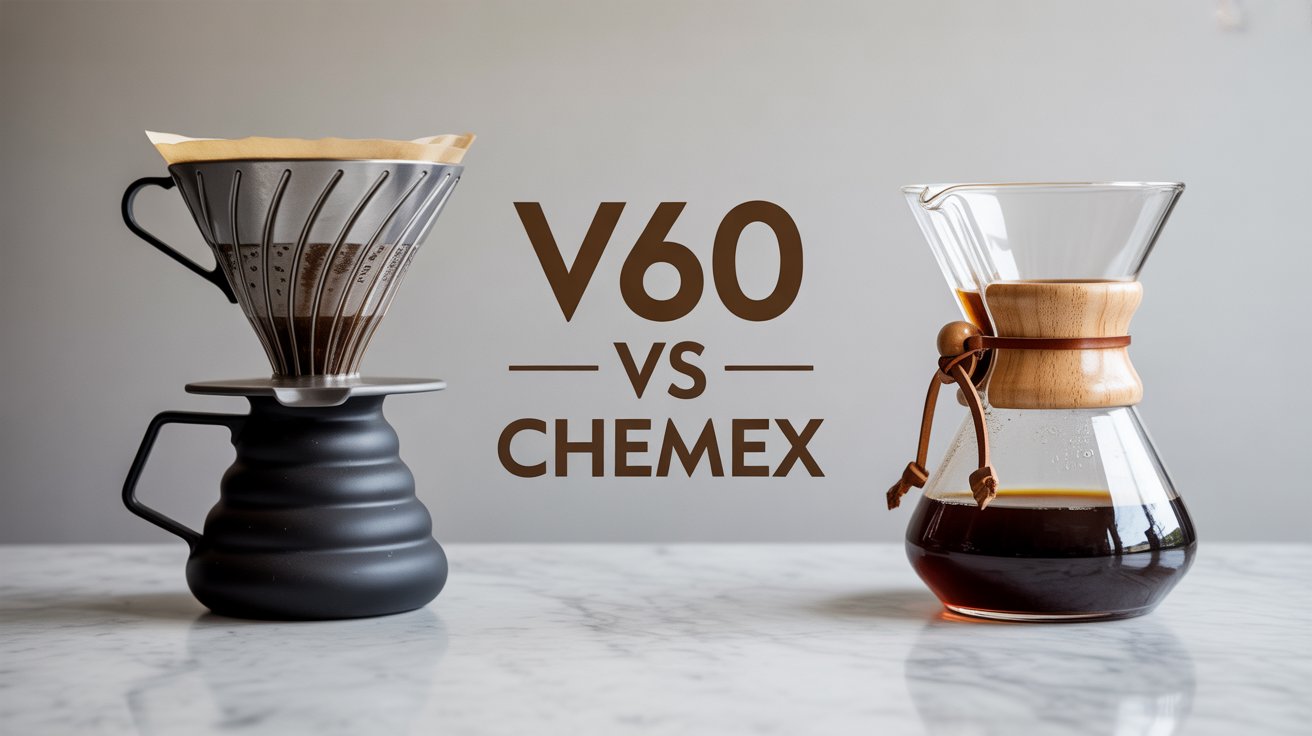
If you’re wondering which makes better coffee — the V60 or the Chemex — here’s the fast answer:
The V60 gives you more control and complexity; the Chemex delivers cleaner, smoother cups with zero fuss.
Most people don’t realize this until they’ve wasted beans, messed up pours, or bought the wrong brewer altogether. I’ve been there — brewing muddy cups, over-extracting on one device, under-extracting on the other, and thinking “Aren’t they both just pour-overs?”
They’re not. Not even close.
The real difference comes down to filter thickness, flow rate, and how much control you want. And once you understand that, choosing between them becomes stupidly simple.
So in this guide, we’ll break down V60 vs Chemex in a way that helps you pick the right brewer today — no geeky jargon, no guesswork, just clear, tested insights that actually matter in your daily coffee routine.
Quick Summary — At a Glance
If you want maximum control, brighter complexity, and a hands-on brewing experience → pick the V60.
If you want cleaner cups, smoother clarity, and an elegant all-in-one brewer → pick the Chemex.
Most people spend weeks comparing drippers, filters, and techniques. You don’t need to. The real choice comes down to flow rate, filter thickness, and how much control you actually want during brewing.
Here’s the fast breakdown:
| Feature | V60 | Chemex |
|---|---|---|
| Brew Time | ~2:00–3:00 min (fast flow) | ~3:30–4:30 min (slow flow) |
| Grind Size | Medium-fine | Medium-coarse |
| Flavor Profile | Bright, complex, expressive | Clean, smooth, tea-like |
| Batch Size | 1–2 cups | 2–8 cups |
| Ease of Use | High control, less forgiving | Simple, consistent |
| Price Range | Low to mid | Mid to high |
What Are V60 and Chemex — What Makes Them Different
Before we compare them side-by-side, you need to know why these brewers aren’t just “two versions of the same thing.” Each one brews with a different rhythm, different filters, and a different flavor philosophy. Here’s the fast primer.
What Is the V60? (Design, Filter, Materials)
Searchers want clarity, so here’s the clean breakdown.
The Hario V60 is a cone-shaped dripper engineered for precision. Its spiral ribs, 60-degree angle, and single large drainage hole work together to speed up flow and amplify control. You influence everything — from extraction speed to turbulence — with your pour.
This matters because the V60’s thin, oxygen-bleached paper filters allow more oils and aromatics to pass through, creating richer body and more vibrant flavor expression. Materials vary — ceramic for heat retention, glass for stability, stainless steel for durability, and plastic for portability.
From experience, the V60 feels like a brewer that rewards practice. Once you dial in your grind and pour technique, it gives you unmatched flexibility across single-origin beans, especially washed Ethiopians and light-roast Colombians that shine with clarity and fruit notes.
What Is the Chemex? (Design, Filter, Materials)
The Chemex is both a brewer and a serving carafe — an hourglass-shaped piece of glassware designed by Peter Schlumbohm and featured in the MoMA design collection. Its iconic wooden collar, polished leather tie, and seamless carafe design make it both functional and aesthetic.
Chemex uses a proprietary thick paper filter—about 20–30% thicker than standard pour-over filters. This slows the flow rate, reduces sediment, and creates the signature tea-like clarity Chemex is known for. Because the filter hugs the walls of the carafe, the extraction behaves more like a hybrid of immersion and percolation.
In real-world use, Chemex shines when brewing for groups. The larger 6–10 cup sizes let you produce consistently clean batches without micromanaging technique. It’s popular in specialty cafés for its presentation and repeatability.
Why Filter + Grind + Brew Time Matter (Fundamentals of Pour-Over Physics)
Pour-over brewing revolves around flow rate, particle size, and filter resistance.
Change one variable, and extraction changes with it.
Filter Thickness:
The V60’s thin paper allows faster drainage and more oils. That leads to brighter acidity, more aromatics, and greater flavor separation.
The Chemex’s thick paper increases resistance, traps oils, and lengthens contact time — producing smoother sweetness and a polished, lighter body.Grind Size:
Because the V60 drains quickly, you use a medium-fine grind to ensure proper extraction.
Chemex demands a medium-coarse grind to avoid choking the filter and slowing down the brew to a bitter crawl.Brew Time:
Faster brews (V60) emphasize complexity and crisp acidity.
Slower brews (Chemex) emphasize clarity, sweetness, and balance.
I’ve tested both side-by-side using the same washed Ethiopia Yirgacheffe. The V60 brought out lemon brightness and jasmine aromatics. The Chemex produced a rounder, cleaner cup with a softer floral finish. Same bean. Completely different sensory experience.
V60 vs Chemex — Side-by-Side Comparison
If you want a complex, fuller-bodied cup with more control → choose the V60.
If you want a smoother, cleaner, “tea-like” brew for multiple servings → choose the Chemex.
Flavor & Cup Profile (Taste, Body, Clarity)
Flavor is the #1 deciding factor for most home brewers, and these two brewers sit on opposite ends of the pour-over spectrum.
V60 produces a fuller-bodied, more textured cup.
Its thinner paper filters and open-bed design allow more coffee oils and microfines into the cup. You get deeper flavor, stronger aromas, and more nuance—especially noticeable with single-origin beans from Ethiopia, Kenya, or Colombia.
This is why many baristas and roasters (including those at specialty cafés in Tokyo, Melbourne, and Portland) prefer the V60 for flavor exploration.
Chemex delivers a cleaner, smoother, clearer cup.
Its proprietary thick filters remove most oils and fines, boosting clarity and creating a lighter mouthfeel. The result feels “tea-like”—bright, crisp, and exceptionally clean.
If you love a soft, easy-drinking profile—think washed Latin American coffees—Chemex is unbeatable.
Quick takeaway:
Want complexity + texture → V60
Want clarity + smoothness → Chemex
Brew Variables — Grind Size, Brew Time, Pour Technique & Control
Real control comes from grind size, flow rate, and pour style. Here’s how each brewer behaves.
V60 favors a medium-fine grind and a faster flow.
Its large central hole and spiral ribs make it highly responsive to your pouring technique.
Small changes in:
flow speed
bloom behavior
circular vs center pouring
can significantly shift the flavor.
This gives advanced brewers incredible control—but it also means beginners may experience inconsistency.
Chemex uses a medium-coarse grind and brews slower.
The thick filters slow extraction, making it more forgiving if your pour rate or bloom isn’t perfect.
You get consistency—batch after batch—even without mastering the finesse of competitive pour-over routines.
In short:
Want precision and flexibility → V60
Want consistency without effort → Chemex
Batch Size, Serving Style & Use Cases
Batch size is a major deciding factor that many beginners overlook.
V60 excels for single cups or small servings.
It’s compact, quick to set up, and perfect for daily solo use. Travelers and minimalists love it because a single plastic V60 plus a gooseneck kettle is all you need.
Chemex shines when brewing for 2–4 people.
Its built-in carafe keeps coffee warm longer and serves beautifully straight from the glass body.
It’s the brewer you pull out when guests arrive—part functional brewer, part centerpiece.
Use it like this:
Morning solo brew → V60
Weekend brunch or hosting → Chemex
Convenience, Ease of Use & Practical Considerations
Convenience matters more than people admit.
V60 requires more attention.
You need:
consistent grind quality
controlled pouring
accurate timing
awareness of flow rate
If you enjoy the craft and ritual, it rewards you. If you’re half-awake at 7 AM… maybe not.
Chemex feels easier for most people.
The thicker filter smooths out mistakes, especially with larger batches.
Just pour slow, keep the water level steady, and the brewer does most of the work.
Durability & maintenance:
V60: plastic is nearly unbreakable; ceramic and metal are durable; cleanup is simple.
Chemex: beautiful but fragile; thick filters cost more and require careful handling; cleaning the carafe takes effort unless you use a brush.
Practical takeaway:
Want “set it and forget it” ease → Chemex
Want hands-on control → V60
Cost & Value (Initial Investment + Ongoing Costs)
Both brewers are affordable, but long-term cost differs.
V60 pricing:
Entry-level plastic versions cost very little.
Ceramic or metal models cost more but last for years.
Filters are inexpensive and widely available.
This makes V60 the better “budget-conscious” option.
Chemex pricing:
The brewer itself costs more due to the hand-blown glass and trademarked design.
Filters are significantly more expensive long-term.
Replacement costs matter because Chemex glass breaks easily.
However, many buy Chemex as both a brewer and a beautiful piece of kitchen design.
Value by lifestyle:
Want low cost + maximum flexibility → V60
Want premium aesthetics + multi-cup brewing → Chemex
Who Should Use Which — Buyer Personas & Use Cases
Choose the V60 if you:
Brew mostly for yourself
Love experimenting with pour techniques
Prefer complex, layered flavor
Want low upfront + ongoing costs
Enjoy the hands-on ritual
Prefer switching between beans like single-origin Ethiopian or Kenyan coffees
Choose the Chemex if you:
Brew for 2 or more people regularly
Prefer clean, smooth, tea-like flavor
Want consistency without focusing on technique
Love minimalistic, premium design objects
Value the brewer-as-carafe combo
Don’t mind spending more on filters and glassware
How to Brew Right — Best Practices for Each Method
Before you touch the kettle, here’s the truth: both the V60 and Chemex only shine when you dial in the basics. Grind, water temp, pour rhythm—each tiny move changes the entire cup. Let’s break down the exact steps so you brew them right every time.
Recommended V60 Brewing Steps & Tips
The V60 rewards precision. Small changes to grind, pour rhythm, or bloom can make or break your cup. The steps below follow standard specialty coffee guidelines used in cafés from Oslo to Melbourne.
Optimal Specs for V60
Grind: medium-fine (similar to table salt)
Ratio: 1:15–1:17 (e.g., 15 g coffee → 250 g water)
Water Temp: 92–96°C (197–205°F)
Brew Time: 2:30–3:00 minutes
Step-by-Step V60 Workflow
Rinse your thin V60 filter to remove papery flavors and preheat the ceramic or plastic dripper.
Add ground coffee and create a level bed.
Bloom: Pour 2× coffee weight (e.g., 30 g water for 15 g coffee). Let it degas for 30–45 seconds.
Pour steadily in concentric circles, keeping the water level consistent and avoiding the edges where coffee can stick.
Let the slurry drain while maintaining a smooth flow rate.
Remove dripper, swirl the server gently, and serve immediately.
Pro Tips from Real-World Barista Practice
Use a gooseneck kettle like the Hario Buono for better flow control.
Stir or swirl after the final pour to redistribute oils and dissolve remaining solubles.
Don’t grind too coarse—V60 loses its complexity if extraction is too fast.
Plastic V60 holds heat better than ceramic in cold climates.
Common V60 Mistakes
Pouring too aggressively → channeling.
Blooming for less than 30 seconds → sour flavors.
Ignoring grind consistency → uneven extraction.
Using very light roasts with too coarse a grind → weak cup.
Mini V60 Cheat Sheet
More clarity → slightly finer grind.
More body → slightly coarser grind + slower pour.
Brighter cup → shorter brew time.
Deeper cup → extend total brew time with slower pours.
Recommended Chemex Brewing Steps & Tips
The Chemex thrives with balanced technique and proper filter handling. Its thicker paper requires a slower flow, which affects grind, bloom, and total volume.
Optimal Specs for Chemex
Grind: medium-coarse (similar to sea salt)
Ratio: 1:15–1:16
Water Temp: 92–96°C
Brew Time: 3:30–5:00 minutes
Best For: 2–4 cup batches
Step-by-Step Chemex Workflow
Fold and seat the thick Chemex filter, ensuring the triple-layer side faces the spout.
Rinse heavily—the Chemex filter holds more paper taste than standard filters.
Add grounds and shake gently to level the bed.
Bloom generously: 3× coffee weight because of slower flow.
Pour slowly in circles, keeping the water level about 1–2 cm above the grounds.
Let the water draw down naturally before serving from the glass carafe.
Practical Chemex Tips
A medium-coarse grind prevents choke-ups caused by the dense filter.
Use a scale like the Acaia Pearl for accurate dosing in larger batches.
Don’t overfill—Chemex brews best when used at its intended volume.
Swirl the final brew to enhance aromatics and balance.
Handle the glass carefully; thermal shock cracks cheaper models easily.
Common Chemex Mistakes
Pouring too fast → weak, under-extracted coffee.
Skipping filter rinse → paper taste dominates.
Using a medium grind → slow drawdown and bitterness.
Brewing single cups → Chemex is optimized for multi-cup extractions.
Mini Chemex Cheat Sheet
Cleaner cup → maintain steady slow pours.
More body → slightly finer grind but avoid clogging.
Brighter cup → increase ratio (1:16).
Stronger cup → adjust grind finer by a small increment.
Common Myths & Mistakes (What People Get Wrong)
Most brewing frustration comes from simple misconceptions. Fix these and your coffee improves instantly—regardless of brewer.
Myth: “V60 always makes stronger coffee.”
Not true. Strength depends on brew ratio, grind size, extraction time, roast level, and pour technique.
A coarse grind V60 can taste lighter than a well-dialed Chemex.
Mistake: Using the same grind for both methods.
V60 needs medium-fine; Chemex needs medium-coarse.
Mixing these results in either:
fast, sour brews (too coarse in V60)
clogged, bitter brews (too fine in Chemex)
Myth: “Chemex is always easier.”
Only partially true.
Chemex is more forgiving in flow rate, but poor technique still yields weak or flat coffee.
You still need:
correct water volume
consistent temperature
a balanced grind
proper filter prep
Mistake: Reusing filters.
Both V60 and Chemex filters are designed for single use. Reusing them traps old oils and bitter compounds.
Mistake: Not rinsing filters.
This introduces papery flavors, especially noticeable in Chemex’s thicker filters.
Mistake: Pouring too fast or ignoring bloom.
Fast pours → uneven extraction.
Skipping bloom → trapped CO₂ → sour, muddy flavor.
Mistake: Using wrong water temperature.
Below 92°C → flat, sour coffee.
Above 96°C → harsh, bitter notes.
Which Brewer to Buy — Quick Buyer Guide (If You’re in the Market)
If you’re choosing between the V60 and Chemex, the easiest way to decide is to match the brewer to your volume, workflow, and taste profile.
What to Know Before Buying
Most buyers fall into three buckets:
Solo drinkers who want speed and control.
Households or hosts who brew multiple cups.
Aesthetic-driven buyers who treat brewing like a ritual.
V60 Buying Guide
The Hario V60 comes in multiple materials—plastic, ceramic, metal, and glass—each with small but meaningful differences.
Materials
Plastic (Hario V60 02 Clear) → cheapest, best heat retention, ideal for beginners.
Ceramic → heavier, retains heat well, feels premium.
Metal (Copper/Steel) → most durable and heats rapidly.
Glass → beautiful but fragile, often paired with silicone bases.
Sizes
01 → single cup
02 → 1–2 cups (most common)
03 → large batches
Who Should Choose V60
Pick the V60 if you:
Brew one cup at a time.
Prefer brighter, more expressive coffees.
Like dialing in variables (pour rate, grind tweaks, bloom).
Want a budget-friendly entry point.
Travel often—plastic V60 is nearly indestructible.
Chemex Buying Guide
The Chemex Classic Series provides a built-in glass carafe and is known for its sculptural design, walnut collar, and heavy filters.
Sizes
3-cup → small households
6-cup → most versatile
8-cup → entertaining, brunch brewing
10-cup → small office or heavy daily use
Filters
Chemex uses its proprietary bonded thick-paper filters. They cost more but produce a signature clean cup.
Who Should Choose Chemex
Pick a Chemex if you:
Brew for 2–4 people.
Want a cleaner, smoother, “tea-like” cup.
Prefer a simple, forgiving brewing style.
Like your brewer to double as a serve-ready carafe.
Value design—Chemex sits in the Museum of Modern Art for good reason.
Starter Kits (If You’re New)
A good beginner setup avoids overthinking.
V60 Starter Kit
V60 02 plastic dripper
Gooseneck kettle (simple stainless model)
Burr grinder (entry-level, manual or electric)
V60 paper filters
Perfect for learning fundamentals without spending big.
Chemex Starter Kit
6-cup Chemex
Chemex bonded filters
Gooseneck kettle
Medium-coarse capable burr grinder
Best for households and guests who enjoy clean, consistent brews.
Upgrade Kits (For Enthusiasts)
If you love precision or want café-level consistency:
V60 Enthusiast Kit
Metal or ceramic V60
Acaia Pearl or Timemore Black Mirror scale
High-end grinder (flat or conical burr)
Temperature-stable electric kettle
Ideal for experimenting with single-origin coffees.
Chemex Enthusiast Kit
8-cup Chemex
Premium bonded filters
Precision kettle with flow control
High-capacity grinder
Designed for people who brew large, high-clarity batches.
When Neither Is Enough — Alternatives & Complementary Options
Some coffee drinkers want something the V60 and Chemex can’t fully deliver—either more body, more convenience, more automation, or a different type of extraction altogether.
Below are smart alternatives based on your brewing personality.
Flat-Bottom Pour-Over Drippers
If you prefer consistency over technique, flat-bottom drippers offer a middle ground.
Kalita Wave / Fellow Stagg [X]
These brewers produce:
Less channeling
More even extraction
A rounder, more balanced cup
They’re great if you want pour-over clarity without the sensitivity of the V60.
Immersion Brewers
If you want richer body and less fuss, immersion methods shine.
French Press
Delivers bold, full-bodied coffee with maximum oils.
Best for people who like deep flavors and minimal steps.
Clever Dripper
Hybrid immersion + drip.
You get strong flavor with more clarity than French press.
AeroPress
Portable, fast, endlessly customizable.
A favorite among travelers, students, and competitors in the World AeroPress Championship.
Automatic Drip Brewers
If you want pour-over quality without manual pouring, consider automation.
Companies like Technivorm, Breville, and Ratio
Modern automatic brewers mimic pour-over patterns using pre-infusion, controlled flow, and optimal temperatures.
Perfect for:
Busy mornings
Multi-cup households
People who want set-and-forget brewing
Cold Brew or Iced Options
If you drink iced coffee frequently, neither V60 nor Chemex will optimize cold extraction.
Cold Brew Makers / Immersion Jars
Offer smoother, low-acidity iced coffee with minimal effort.
Espresso or Stovetop
If you’re chasing intensity or café-style drinks:
Espresso machines offer crema, pressure, and microfoam pairing.
Moka pots offer a budget-friendly “espresso-like” concentrate.
Which Alternative Is Best for You?
Want clarity with fewer variables? → Kalita Wave
Want richness? → French Press
Want versatility + portability? → AeroPress
Want convenience? → Automatic drip brewer
Want iced coffee? → Cold brew system
Want intensity? → Espresso or Moka
FAQ
What’s the main difference between a V60 and a Chemex?
V60 uses a thinner filter and lets more oils and fines pass through, giving a fuller, more textured flavor. The Chemex uses a thicker, bonded filter that catches more oils and sediment — resulting in a cleaner, smoother, lighter-bodied cup.
Which grind size should I use for V60 vs Chemex?
For V60, use a medium-fine grind. For Chemex, go medium-coarse. The difference compensates for filter thickness and flow rate so extraction stays balanced.
Is Chemex easier for beginners than V60?
Often yes — because its thick filter and slower drip make it more forgiving of pour technique and grind mistakes. That said, you still need decent grind and water control for the best results.
Which brewer is better for brewing multiple cups vs a single cup?
If you brew for one or two — V60 works great because it brews quickly and is compact. If you brew for 2–4+ or want to serve several cups at once — Chemex wins thanks to its larger carafe and multi-cup capacity.
Can I use the same grind/ratio for both V60 and Chemex?
Not recommended. Using the same grind or ratio usually results in over-extraction or bitterness with Chemex, or a weak, under-extracted cup with V60. Each brewer needs its own optimized settings.
Conclusion
You now know exactly where the V60 shines, where the Chemex wins, and how to choose the brewer that matches your taste, workflow, and brewing style. No guesswork. No “hope this works” mornings.
Pick the one that fits your routine and start dialing in your best cup — even a small tweak in grind or filter can change everything. And if you want to go deeper, check out our guide on pour-over fundamentals to level up your technique even faster.
Try one method this week, track your results, and refine. Great coffee isn’t complicated — it’s consistent, intentional, and absolutely within your reach.

Shahriar brings a unique blend of storytelling prowess and digital expertise to Daily Coffee Guide. With a background in SEO and content strategy, he ensures our articles on Beans, Coffee, Tea, and Drinks are both engaging and discoverable. His passion for coffee culture drives him to explore and share the rich narratives behind every cup.