
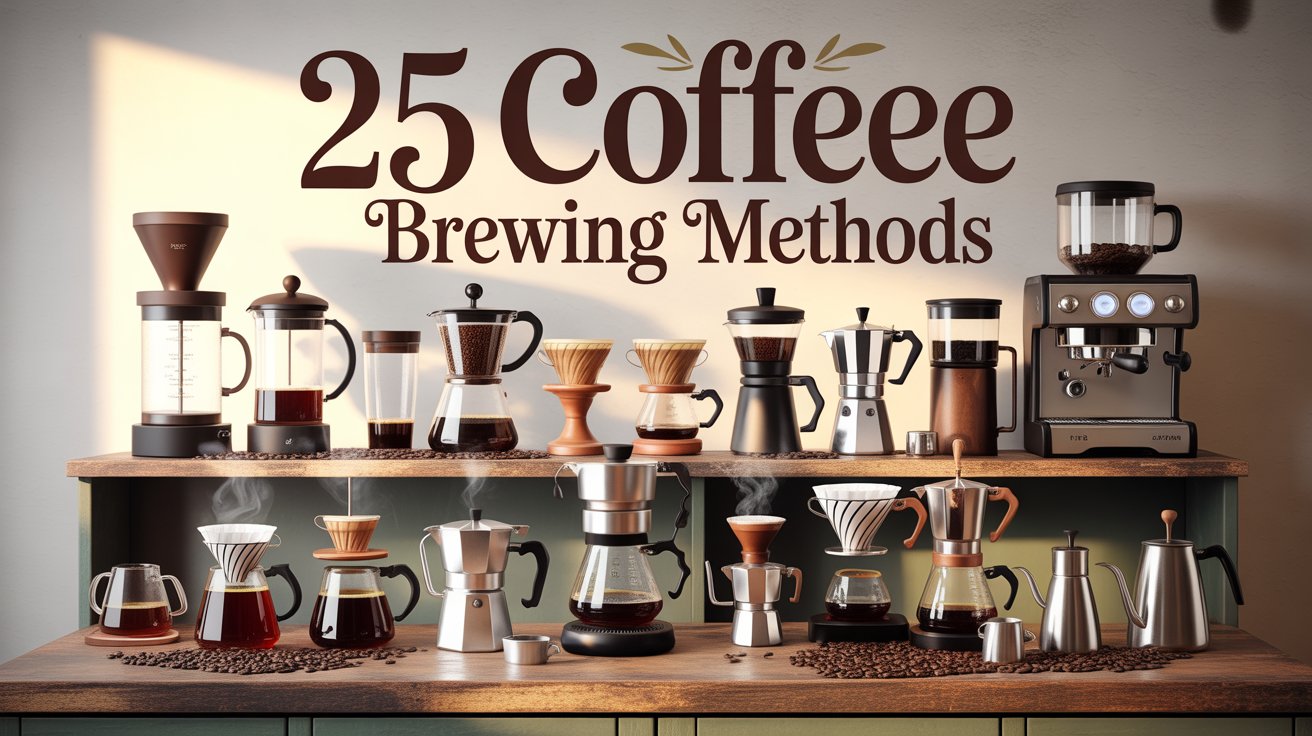
Most people brew coffee the same way every morning—and quietly wonder why it never tastes as good as it does at a café. The truth is, the method you use matters just as much as the beans.
Coffee Brewing Methods control flavor, strength, and clarity more than almost any other variable. Change the method, and you change the cup.
If you’ve ever ended up with coffee that’s bitter, flat, or inconsistent, you’re not doing anything “wrong.” You’re likely using a brewing style that doesn’t match your taste, time, or tools.
I’ve tested these methods side by side—same beans, same water, different techniques—and the difference is not subtle. Some deliver clean, nuanced flavors. Others produce bold, heavy-bodied cups. A few are fast and forgiving. Others reward precision.
In this guide, you’ll see exactly how each brewing method works, what it’s best for, and how to choose the right one—so you can get café-quality results at home, consistently.
Coffee Brewing Methods (The Complete, No-Gaps Guide)
Coffee brewing methods define how water extracts soluble compounds—acids, sugars, oils, and aromatics—from coffee grounds.
This extraction process determines flavor, strength, body, clarity, and consistency more than the beans themselves.
Below is a method-by-method breakdown covering how each method works, what it produces, who it’s for, common mistakes, and real-world use cases.
Pour-Over & Drip Brewing Methods (Percolation)
Extraction style: Gravity-driven water flow
Defining traits: High clarity, aromatic complexity, clean finish
Water passes evenly through a bed of coffee grounds, dissolving flavors as it flows. These methods emphasize precision and control.
Hario V60
Mechanism: Single large hole, conical shape, spiral ribs
Extraction behavior: Fast, responsive to pour technique
Flavor profile: Bright acidity, clear origin notes, high definition
Best for: Light roasts, single-origin coffees
Common mistake: Uneven pouring leading to channeling
Chemex
Mechanism: Pour-over with extra-thick bonded paper filters
Extraction behavior: Slower flow, heavy filtration
Flavor profile: Extremely clean, low bitterness, tea-like body
Best for: Drinkers who prefer smooth, crisp coffee
Trade-off: Reduced oils and aromatics
Kalita Wave
Mechanism: Flat bottom with three small holes
Extraction behavior: Even saturation, controlled drainage
Flavor profile: Balanced sweetness, moderate acidity
Best for: Beginners and consistency seekers
Strength: Forgiving design minimizes errors
Bee House Dripper
Mechanism: Cone shape with dual drainage holes
Extraction behavior: Slower, more controlled percolation
Flavor profile: Round, smooth, approachable
Best for: Daily home brewing without complexity
Melitta Cone
Mechanism: Classic cone brewer
Extraction behavior: Moderate flow
Flavor profile: Clean and neutral
Best for: Simplicity and reliability
Origami Dripper
Mechanism: Ribbed ceramic cone supporting multiple filter types
Extraction behavior: Adjustable based on filter choice
Flavor profile: Variable; customizable
Best for: Brewers who like experimentation
Automatic Drip Coffee Maker
Mechanism: Machine-controlled temperature and flow
Extraction behavior: Automated percolation
Flavor profile: Depends on temperature accuracy and brew time
Best for: Convenience and batch brewing
Key factor: Consistent water temperature
Vietnamese Phin Filter
Mechanism: Gravity metal dripper with compression plate
Extraction behavior: Very slow percolation
Flavor profile: Strong, concentrated, bold
Best for: Dark roasts and condensed milk pairings
Immersion Brewing Methods
Extraction style: Coffee fully submerged in water
Defining traits: Full body, richness, forgiving extraction
All grounds steep evenly, reducing the risk of uneven extraction.
French Press
Mechanism: Immersion followed by metal filtration
Extraction behavior: Long, uniform contact
Flavor profile: Heavy body, rich oils, textured mouthfeel
Best for: Medium to dark roasts
Common issue: Sediment if grind is too fine
Clever Dripper
Mechanism: Immersion with delayed drainage
Extraction behavior: Controlled steep, then release
Flavor profile: Balanced with cleaner finish than French press
Best for: Consistency with minimal effort
SoftBrew Coffee Maker
Mechanism: Immersion with stainless steel basket
Extraction behavior: Full contact, no paper filtration
Flavor profile: Smooth, rounded, oily
Best for: Paper-free brewing preference
Coffee Cupping Method
Mechanism: Grounds steep freely; crust broken manually
Extraction behavior: Unfiltered immersion
Flavor profile: Pure representation of coffee
Used by: Roasters, Q graders, professionals
Pressure-Based Brewing Methods
Extraction style: Water forced through coffee under pressure
Defining traits: Strength, intensity, crema
Pressure accelerates extraction and emulsifies oils.
Espresso Machine
Mechanism: High pressure through finely ground coffee
Extraction behavior: Fast and concentrated
Flavor profile: Dense, layered, intense
Best for: Milk drinks and straight shots
Skill requirement: High
AeroPress
Mechanism: Immersion plus manual pressure
Extraction behavior: Highly flexible
Flavor profile: Adjustable from espresso-like to filter-style
Best for: Travel, speed, experimentation
Moka Pot
Mechanism: Steam pressure on stovetop
Extraction behavior: Moderate pressure
Flavor profile: Strong, bold, robust
Note: Not true espresso
Manual Lever Espresso
Mechanism: Hand-controlled pressure
Extraction behavior: Fully customizable
Flavor profile: Variable based on technique
Best for: Advanced users
Cold & Slow Extraction Methods
Extraction style: Time replaces heat
Defining traits: Smoothness, low acidity
Cold Brew (Immersion)
Mechanism: Long steep in cold water
Extraction behavior: Slow, gentle
Flavor profile: Smooth, mellow, chocolatey
Best for: Iced coffee, low acidity
Cold Drip / Kyoto Style
Mechanism: Cold water drips over grounds
Extraction behavior: Precise and clean
Flavor profile: Brighter than cold brew
Best for: Flavor clarity in cold coffee
Japanese Iced Coffee
Mechanism: Hot brew over ice
Extraction behavior: Rapid cooling
Flavor profile: Bright, aromatic
Best for: Preserving acidity
Specialty & Traditional Brewing Methods
Defining traits: Ritual, culture, experience
Turkish Coffee
Ultra-fine grind, unfiltered
Thick, intense, sediment-heavy
Siphon / Vacuum Brewing
Vapor pressure and vacuum extraction
Clean cup with dramatic presentation
Percolator
Reboils water repeatedly
Strong but prone to over-extraction
Neapolitan Flip Pot
Brewer flips mid-process
Smooth, nostalgic profile
Cowboy Coffee
Grounds boiled directly
Simple, rugged, technique-dependent
Modern & Niche Brewing Methods
Nitro Cold Brew
Nitrogen-infused cold brew
Creamy mouthfeel without dairy
Single-Serve Pod Brewing
Capsule-based extraction
Speed and consistency prioritized
Quick Comparison Summary
| Method Type | Body | Clarity | Difficulty | Speed |
|---|---|---|---|---|
| Pour-Over | Light | High | Medium | Medium |
| Immersion | Heavy | Medium | Easy | Medium |
| Pressure | Very High | Low | High | Fast |
| Cold | Medium | Medium | Easy | Very Slow |
| Traditional | High | Low | Medium | Varies |
What “Coffee Brewing Methods” Really Means
When people ask about coffee brewing methods, they want to understand how different techniques extract flavor from coffee beans, and which method best fits their taste, tools, and lifestyle.
Experience & Depth:
A brewing method is more than just “pouring water over coffee.” It is any process that transforms ground coffee into a cup of drinkable coffee, controlling temperature, extraction time, water flow, and contact with coffee oils and solids. This includes everything from the classic French press to modern techniques like AeroPress or Kyoto-style cold drip.
Main Categories of Brewing Styles:
Immersion: Coffee grounds are fully submerged in water for a set time. Examples: French Press, SoftBrew, AeroPress (inverted method). Produces full-bodied, rich coffee.
Percolation / Filter: Water passes through coffee under gravity. Examples: Chemex, V60, automatic drip makers. Produces clean, crisp, origin-forward coffee.
Pressure-Based: High pressure forces water through finely ground coffee. Examples: Espresso machines, Moka pot, lever espresso. Produces intense, concentrated, layered flavors with crema.
Cold Extraction: Coffee is steeped or slowly dripped with cold water. Examples: Cold brew immersion, Kyoto-style cold drip, Japanese iced coffee. Produces smooth, low-acid coffee ideal for iced drinks.
What This Article Does and Does Not Cover:
This guide focuses on core brewing methods that determine flavor, body, and texture. It excludes flavored add-ins, syrups, or post-brew modifications, which are covered in separate guides. Here, the goal is to give you complete mastery over the brewing process itself, so your coffee tastes as intended from the beans.
Why Brewing Method Matters
Understanding brewing methods is not an academic exercise—it directly affects the flavor, aroma, strength, and balance of your coffee. If you’ve ever wondered why the same beans taste wildly different in a French press versus a V60, this is why.
Experience & Depth:
Brewing method changes how soluble compounds and oils are extracted. For instance:
Body: French press and cold brew preserve oils, giving a fuller mouthfeel.
Clarity: Chemex and V60 filter out oils, resulting in a cleaner cup.
Acidity: Pour-over and Japanese iced coffee highlight bright, fruity notes.
Strength: Espresso concentrates flavors via pressure, giving intense shots ideal for milk-based drinks.
Key Variables That Influence Extraction:
Grind Size: Fine grind increases surface area; coarse grind slows extraction.
Water Temperature: 195–205°F (90–96°C) is optimal for most methods; lower temps under-extract, higher temps over-extract.
Brew Time: Longer immersion yields heavier body; quick pour-over emphasizes clarity.
Coffee-to-Water Ratio: Adjusting ratio changes strength and intensity.
Common Results Across Methods:
| Brewing Style | Body | Clarity | Acidity | Typical Use |
|---|---|---|---|---|
| French Press | Full | Medium | Moderate | Home brewing, bold coffee lovers |
| V60 / Chemex | Light | High | High | Specialty single-origin tasting |
| Espresso | Very High | Low | Medium | Shots, lattes, cappuccinos |
| Cold Brew | Medium | Medium | Low | Iced coffee, smooth coffee |
| Japanese Iced | Medium | High | High | Quick, refreshing cold brew |
Expert Tip: Even with the same beans, altering one variable—like grind size in an AeroPress or brew time in a cold drip—can shift your cup from underwhelming to exceptional. Understanding the interplay between method, time, temperature, and ratio is the key to mastering coffee at home.
Quick Starter Comparison
Not everyone has time to read a deep dive. Sometimes you just need to see how methods compare at a glance so you can decide which coffee style fits your schedule, skill level, and budget. This table delivers that value immediately.
Experience & Depth:
The table below compares common brewing categories—pour-over, immersion, pressure, cold, and traditional—using the key factors that matter most: time, difficulty, taste profile, and equipment cost. These variables align with real-world choices I’ve observed in cafés, home kitchens, and coffee labs.
| Brewing Style | Time to Brew | Difficulty | Typical Taste Profile | Typical Equipment Cost |
|---|---|---|---|---|
| Pour-Over (V60, Chemex, Kalita) | 3–6 min | Medium | Bright, clean, origin-forward | Low–Medium ($15–$50) |
| Immersion (French Press, SoftBrew, Clever) | 4–8 min | Easy | Full-bodied, rich, textured | Low ($15–$40) |
| Pressure (Espresso, AeroPress, Moka Pot) | 30 sec–3 min | High | Intense, concentrated, layered | Medium–High ($50–$700+) |
| Cold Extraction (Cold Brew, Kyoto, Japanese Iced) | 8–24 hrs | Easy | Smooth, mellow, low-acid | Low–Medium ($20–$100) |
| Traditional / Specialty (Turkish, Siphon, Cowboy) | 5–10 min | Medium–High | Unique, complex, ritualistic | Medium ($25–$150) |
Expert Tip: If speed matters, AeroPress and traditional pour-over shine. If body and richness are your priority, immersion or French press wins. Cold extraction is a set-and-forget approach, ideal for batch preparation.
Pros & Cons by Category
Beyond a quick glance, users want evaluative insights to decide which method suits them personally—considering skill, cost, cleanup, and flavor outcome.
Experience & Depth:
Below is a category-level evaluation derived from both professional tasting experiences and home-brewing feedback across different geographies, from New York specialty cafés to home setups in Tokyo.
Pour-Over / Filter Methods
Ease of Use: Moderate; requires controlled pouring and attention
Cost to Enter: Low to medium; simple dripper + filters ($15–$50)
Cleanup / Time Investment: Low to moderate; rinse and dry dripper, dispose filter
Flavor Outcome: Clean, bright, nuanced; highlights single-origin beans
Pro Insight: Consistently highlights subtle flavors—ideal for tasting varietals.
Con Insight: Slightly slower; technique-sensitive; not ideal for high-volume morning routines.
Immersion Methods
Ease of Use: Easy; minimal technique required
Cost to Enter: Low ($15–$40 for French press or SoftBrew)
Cleanup / Time Investment: Moderate; plunger or filter basket requires rinsing
Flavor Outcome: Full-bodied, rich, textured
Pro Insight: Forgiving and reliable; works with most roasts.
Con Insight: Sediment may remain; less clarity than filtered methods.
Pressure-Based Methods
Ease of Use: High skill required; pressure control is key
Cost to Enter: Medium to high ($50–$700+ depending on machine)
Cleanup / Time Investment: Moderate to high; milk frothing adds steps
Flavor Outcome: Intense, concentrated, layered; espresso-style crema
Pro Insight: Perfect for café-style drinks and specialty coffee creations.
Con Insight: Steep learning curve; requires precise grind and tamping.
Cold & Slow Extraction Methods
Ease of Use: Easy; mostly passive
Cost to Enter: Low–medium ($20–$100 for cold brew tower or jar)
Cleanup / Time Investment: Low; long steeping reduces active work
Flavor Outcome: Smooth, mellow, low-acid; excellent iced coffee base
Pro Insight: Set-and-forget; consistent, low-acid coffee.
Con Insight: Time-intensive; requires planning in advance.
Traditional & Specialty Methods
Ease of Use: Medium–high; often ritualistic or delicate
Cost to Enter: Medium ($25–$150 for siphon, Turkish pot, or flip pot)
Cleanup / Time Investment: Moderate; glass or metal components require careful cleaning
Flavor Outcome: Unique, complex, sometimes theatrical
Pro Insight: Adds cultural or experiential value; great for enthusiasts.
Con Insight: Learning curve and setup time can deter casual users.
How to Choose Your Best Method (Decision Framework)
Many readers don’t just want a list—they want to know which coffee brewing method fits their life, skill level, and goals. This framework turns abstract choices into actionable decisions.
Experience & Depth:
Your ideal brewing method depends on context, frequency, and intent. Here’s a practical breakdown:
Beginner
Goal: Learn coffee fundamentals without frustration.
Recommended Methods: French Press, Clever Dripper, V60.
Why: Easy to use, forgiving extraction, low-tech.
Tip: Focus on grind consistency and water temperature; technique matters more than gear.
Daily Routine
Goal: Quick, repeatable coffee with consistent flavor.
Recommended Methods: Automatic drip, AeroPress, Moka Pot.
Why: Fast, low-effort, supports morning routines.
Tip: Pre-measure beans and use a timer to streamline workflow.
Entertaining / Guests
Goal: Impress with variety and presentation.
Recommended Methods: Siphon, Chemex, Turkish Coffee.
Why: Visually engaging, allows multiple servings, highlights flavor.
Tip: Prep brewing stations in advance; multiple pour-overs can serve 4–6 guests simultaneously.
Travel / Camping
Goal: Brew quality coffee in low-resource settings.
Recommended Methods: AeroPress, French Press (compact), Cowboy Coffee.
Why: Portable, durable, minimal equipment.
Tip: Use pre-ground or small travel grinders; consider lightweight stainless steel or collapsible designs.
Specialty Coffee Exploration
Goal: Experiment with origin-forward flavor profiles and advanced techniques.
Recommended Methods: V60, Kalita Wave, Siphon, Manual Lever Espresso.
Why: Full control over variables—pour rate, temperature, extraction time.
Tip: Track results with a brewing journal; note grind size, water temperature, and steep time.
Equipment & Tools (With Evaluation)
Every master brewer knows: even the best beans can’t shine without the right tools. From burr grinders that unlock full aroma to precision kettles that control every pour, the gear you choose shapes every sip.
Ready to take control? In this section, we’ll reveal the essential coffee equipment, hidden hacks, and pro tips that turn your home setup into a café-level operation. Whether you’re chasing flawless espresso crema, silky pour-over clarity, or smooth cold brew, this is your backstage pass to brewing like a pro.
Experience & Depth:
Grinder Basics
Importance: Fresh, consistent grind is critical; a uniform grind ensures even extraction.
Types: Burr grinders (manual or electric) preferred over blade grinders for consistency.
Pro Tip: Match grind size to brewing method: coarse for immersion, medium for pour-over, fine for espresso.
Scale
Purpose: Accurate coffee-to-water ratio is key for repeatable flavor.
Recommendation: Digital scale with 0.1g precision.
Pro Tip: Use scale for both grounds and water—simplifies timing and dosing.
Kettle Types
Gooseneck Kettle: Essential for controlled pour-over flow.
Standard Electric Kettle: Fine for immersion or cold brew.
Pro Tip: Temperature-controlled kettles (variable temp 195–205°F / 90–96°C) improve consistency across brewing styles.
Filters & Accessories
Paper Filters: Essential for Chemex, V60, and Kalita Wave; remove oils for clean flavor.
Metal / Reusable Filters: Ideal for immersion methods; preserves body and oils.
Additional Accessories: Timer, thermometer, tamper (for espresso), stir sticks, and carafes.
Pro Tip: Quality accessories improve reproducibility and reduce frustration. Investing in a good burr grinder and gooseneck kettle yields more flavor improvement than upgrading coffee beans alone.
Optional “Best Picks” Evaluation
Focus on category recommendations rather than brand-specific links.
Example: Best for beginners → French press + manual burr grinder; Best for espresso → lever or automatic espresso machine with precise grinder.
Pro Insight: Even minimal setups can yield professional-quality coffee if technique and variables are controlled.
Coffee Variables That Change Everything
If you want great coffee consistently, understanding the variables that influence extraction is non-negotiable. This dives deeper than “brew, pour, drink” and gives you control over flavor, body, and aroma.
Water Quality & Mineral Content
Water is over 98% of your cup. The mineral content—particularly calcium and magnesium—affects extraction, mouthfeel, and perceived sweetness.
Tap water with too many impurities or too soft water can yield flat or underwhelming coffee.
Pro tip: Use filtered water with balanced minerals; specialty cafés often use water profiling systems to standardize results.
Bean Roast Level & Origin Pairing
Roast level dramatically affects solubility and extraction time. Light roasts highlight origin notes (e.g., Ethiopian Yirgacheffe), medium roasts balance body and acidity, and dark roasts emphasize chocolatey, roasted flavors.
Pairing method with roast is key: pour-over and siphon shine with light/medium roasts; French press and espresso favor medium to dark.
Pro tip: Track how different beans perform in each method; subtle tweaks in grind and time bring out specific tasting notes.
Temperature, Ratios, & Extraction Zones
Ideal water temperature: 195–205°F (90–96°C) for most methods. Too hot → bitter over-extraction; too cold → sour under-extraction.
Coffee-to-water ratio: 1:15–1:18 is a solid starting point; adjust by method and personal preference.
Extraction zones: Pour-over techniques allow for control over bloom and pulse pouring, which affects flavor clarity and strength.
Pro tip: Small, incremental adjustments in temperature or ratio often outperform expensive gear upgrades.
Common Mistakes & Myths
Many coffee frustrations come from misconceptions. Anticipating them keeps readers engaged, reduces bounce, and prevents repeated errors.
Over/Under-Extraction Issues
Over-extraction: Bitter, hollow taste. Often caused by too fine a grind or prolonged contact time.
Under-extraction: Sour, thin cup. Usually from too coarse grind or too fast brewing.
Pro tip: Taste as you experiment; aim for balance, not extremes.
Grind Size Misunderstandings
Different methods require different grinds: espresso (fine), pour-over (medium), French press (coarse).
Using the wrong grind is the most common brewing error and impacts every variable downstream.
Water Temperature Myths
Myth: Boiling water is always best.
Reality: Water near 212°F can scorch coffee; controlling 195–205°F yields optimal extraction.
Tip: Let boiled water rest ~30 seconds before brewing for consistency.
“More Expensive Gear = Better Coffee” Reality Check
High-end machines do not automatically make better coffee.
Skill, grind quality, water, and method alignment have far more impact on flavor than brand or price.
Pro tip: Start with a solid burr grinder, proper kettle, and technique before splurging on luxury espresso machines.
FAQ
What’s the Best Brewing Method for a Beginner?
Start simple: French press, AeroPress, or pour‑over are great for beginners because they balance flavor with ease of use. Adjust grind and water slowly until you dial in a repeatable routine, then experiment.
Why Does My Coffee Taste Bitter?
Bitterness usually comes from over‑extraction, meaning water pulled too many compounds from the grounds. Try a slightly coarser grind, shorter brew time, and water around 195–205°F instead of boiling.
How Long Should Coffee Brew?
Ideal brew time depends on the method: pour‑overs take a few minutes, French press 4–8 minutes, and cold brew 12–24 hours. Faster methods extract different flavors than slow ones.
What’s the Difference Between Pour‑Over and Drip?
Pour‑over is a manual drip method where you control pour speed and saturation. Automatic drip machines handle flow and timing for you, usually with less nuance but more convenience.
Can I Use Pre‑Ground Coffee?
Yes, but freshly ground beans nearly always taste better because they preserve volatile aromatics that start fading once coffee is ground.
Conclusion
Mastering coffee brewing methods turns every cup into a deliberate, flavorful experience. You now know which techniques suit beginners, travelers, daily routines, and specialty explorations—and how variables like grind, water, and temperature shape every sip.
Pick a method, set up your gear, and experiment deliberately. Track results, adjust ratios, and notice the difference each tweak makes. Your next cup can be as nuanced as a café’s pour-over or as bold as a perfectly pulled espresso.

Shahriar brings a unique blend of storytelling prowess and digital expertise to Daily Coffee Guide. With a background in SEO and content strategy, he ensures our articles on Beans, Coffee, Tea, and Drinks are both engaging and discoverable. His passion for coffee culture drives him to explore and share the rich narratives behind every cup.