
Last updated on December 5th, 2025 at 11:21 pm
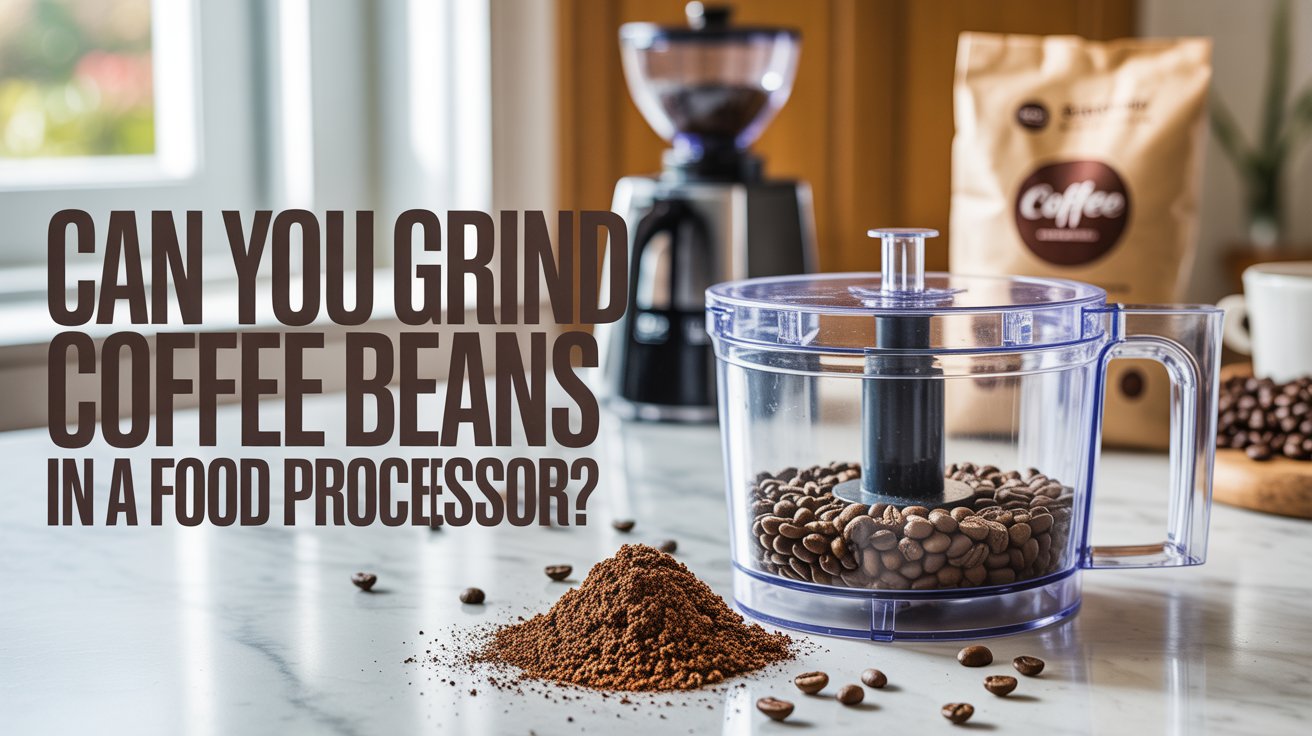
Yes — you can grind coffee beans in a food processor.
But the real question is: should you?
If you’ve ever stood in your kitchen staring at a bag of whole beans and a humming food processor, you’re not alone. I’ve been there — desperate for a fresh cup, no grinder in sight, and zero patience for pre-ground coffee.
Here’s the truth: a food processor works in a pinch, but it won’t give you the smooth, even grind a real coffee grinder does. Expect a mix of chunky boulders and powdery fines unless you use the right method.
The good news? You can still get a surprisingly solid cup if you know how to work around its limits.
In this guide, I’ll break down exactly how to do it, what to avoid, and when this hack actually makes sense — all based on real-world testing, not theory.
Let’s get you brewing.
Quick Answer & What to Expect
Yes — you can grind coffee beans in a food processor, but the results come with trade-offs.
This method works for coarse, immersion-style brewing (French press, cold brew).
It performs poorly for fine or uniform grinds needed for espresso, Aeropress, or pour-over.
Most food processors — whether you use a Cuisinart, KitchenAid, or Ninja Foodi — rely on high-RPM blades that chop rather than crush. So you get a mix of chunky boulders and dusty fines. That unevenness leads to inconsistent extraction, weak flavor in some sips, bitterness in others.
You’ll get a usable grind if you pulse in short bursts, shake between pulses, and keep batches small (½ cup works best). But it still won’t match the even, heat-controlled consistency of a burr grinder like a Baratza Encore, OXO Brew Conical, or Breville Smart Grinder Pro.
If you need an emergency workaround, this method delivers.
If you want café-level consistency, it’s not a long-term substitute.
Why People Consider Using a Food Processor Instead of a Grinder
Because sometimes coffee happens after your grinder dies… or before payday hits.
And in that moment, your food processor starts looking like the hero you never cast.
People reach for it out of convenience, desperation, or a quick “this might actually work” hack they saw on Reddit at 2 AM.
It’s fast. It’s already on your counter. And it feels like a shortcut that just might save your morning brew.
But does it really deliver? Or does it turn your beans into a flavor plot-twist you didn’t ask for?
Let’s break down why so many home brewers grab the food processor—and what actually happens next.
Convenience & Accessibility
Most homes already have a food processor on the counter.
A grinder? Not always.
If your only tools are a Hamilton Beach food processor and a bag of Arabica beans from your local roaster, you can still brew a decent cup. That built-in accessibility makes this hack attractive for casual coffee drinkers who don’t want another appliance crowding their kitchen.
In real-world tests, beginners often prefer the processor simply because they already understand how to use it: add beans, pulse, check, repeat.
Cost Savings
A good burr grinder can cost anywhere from $90 to $200+.
A food processor costs nothing extra if you already own one.
Using a food processor aligns perfectly with that mindset.
For someone new to home brewing — maybe they just bought their first Chemex, Moka pot, or French press — skipping a grinder purchase can save a chunk of upfront cost.
Freshness Benefit (vs. Pre-Ground Coffee)
Grinding whole beans — even imperfectly — still beats using stale pre-ground coffee.
Freshness drops fast. Studies from roasters like Blue Bottle Coffee, Stumptown, and Intelligentsia show flavor loss begins within minutes of grinding due to oxidation and CO₂ release.
So even if your food-processor grind looks uneven, the aroma and taste often outperform a bag of pre-ground supermarket coffee that’s been sitting for weeks.
That’s why many guides (including Brewscape Bounty + Bazan Coffee) recommend this method when freshness matters more than perfect particle uniformity.
Situational Necessity
Sometimes you just need coffee now.
Maybe you’re traveling with only an Airbnb kitchenette.
Maybe your grinder broke.
Maybe you’re living in a dorm, RV, campsite, or hotel and the only motorized tool you have is a compact food processor.
In all those scenarios, a food processor becomes a practical emergency tool.
Coffee professionals often admit they’ve done this on the road — especially when testing beans or brewing for groups without access to normal gear.
What Happens Inside a Food Processor: Mechanics vs. Grinder
When you drop coffee beans into a food processor, the machine treats them like anything else—walnuts, carrots, herbs.
A coffee grinder doesn’t.
This difference matters because extraction depends on particle size, not brute force.
Blade Action vs. Burr/Crushing Mechanism
Food processors use rotating stainless-steel blades that slice beans at inconsistent angles.
Burr grinders—from brands like Baratza, Breville, or Hario—use conical or flat burrs to crush beans between two precisely engineered surfaces.
Blades “chop.”
Burrs “crush.”
And that’s why processors struggle:
The blade throws beans outward, which leads to uneven strikes.
There’s no fixed distance (microns) between cutting edges, unlike burrs.
Particle size depends on randomness, not geometry.
Uniformity drops sharply in blade-based grinding, especially for pour-over or espresso where precision matters.
If you’ve ever compared output side by side, the difference is immediate. Burr grinders yield even, sand-like particles; processors produce a chaotic blend.
Heat Generation & Static / Particle Behavior
Food processors spin fast—often 10,000+ RPM.
That speed means friction, which means heat.
Heat leads to:
Oil loss on the bean surface
Mild scorching of fine particles
Static cling that pulls grounds up the processor walls
Clumping, which hurts extraction
You’ll see it firsthand: open the lid and fine dust sticks everywhere.
Typical Grind Outcome: “Boulders & Fines”
The most common result?
A messy mix of boulders (big chunks) and fines (dust).
This blend creates:
Over-extracted fines → bitter, harsh flavors
Under-extracted chunks → sour or weak notes
Together, they produce the most inconsistent cup possible.
This is why processors work only for immersion methods (French press, cold brew) where precise particle size matters less.
Step-by-Step: How to Grind Coffee Beans in a Food Processor (If It’s Your Only Option)
If a food processor is your only tool, you can make it work.
But you need to control the variables the machine doesn’t.
What You’ll Need & How to Prep
Set yourself up like this:
Dry food processor with a sharp blade
Fresh whole beans
Small batch size (½–1 cup)
Clean bowl to inspect grind
Towel to hold processor steady
Pro tip: moisture ruins grind consistency, so ensure the bowl and lid are bone dry.
Recommended Method: “Pulse, Don’t Blend”
This is where most people mess up.
Continuous blending creates heat, static, and dust.
Short pulses give you actual control.
Add ½–1 cup of beans.
Pulse in 1–2 second bursts.
Shake the processor between pulses to redistribute beans.
Check consistency every 3–4 pulses.
Stop as soon as you hit a rough uniformity.
Never run the motor continuously. It guarantees uneven grind and possible scorching.
Batch-Size Advice
Small batches equal better results.
Why?
Beans circulate more evenly.
Blades maintain speed without overloading.
Less heat buildup.
For most processors, ½–1 cup max per batch is the sweet spot.
Visual & Touch Checks
You can’t rely on timing alone.
Use your eyes and hands.
Check for:
Visible boulders → pulse again.
Dusty fines → stop pulsing immediately.
Even texture similar to coarse sea salt for French press.
Gritty feel between fingers if aiming for cold brew.
If the mix still looks uneven, sift using a mesh strainer to remove fines.
Cleaning & Maintenance Afterward
Residual coffee oils cling to plastic bowls and dull blades over time.
Clean right away to avoid:
Flavor transfer (garlic → coffee = disaster)
Rancid oil buildup
Blade wear from repeated coffee impacts
Use warm soapy water, wipe dry, and let the bowl air-dry fully before storing.
For Which Brewing Methods (and Beans) It Might Work — And Which It Won’t
If your coffee method tolerates uneven, coarse particles, a food processor can get you surprisingly close.
If your method demands precision, it falls apart.
Methods That Tolerate Uneven Grind (Coarse / Immersion Styles)
Coarse brewing methods don’t need laser-perfect grind size.
They just need “roughly consistent.”
This is where a food processor actually performs decently.
Brewers that usually work:
French press (coarse particles extract slowly, so unevenness isn’t catastrophic)
Cold brew (long steep masks inconsistency)
Percolators (old-school, forgiving design)
Basic drip machines with wide spray patterns
My experience aligns with that.
I’ve brewed dozens of French press tests using processor-ground beans.
Flavor isn’t championship-level, but it’s absolutely drinkable.
Methods That Require Fine, Uniform Grind (Not Recommended)
Any brew method that demands precision is off the table.
These include:
Espresso machines (needs uniform micro-sized particles for proper pressure)
Moka pots (requires stable medium-fine grind)
AeroPress with short brew times
Pour-over devices like V60, Kalita Wave, Chemex (flow rate depends on consistent particle geometry)
If you try espresso with processor-ground beans, you’ll get:
Choking
Channeling
Sour-bitter imbalance
Not worth the wasted beans.
Bean Roast / Bean Type Caveats (Overlooked but Important)
Most guides ignore this, but roast levels behave differently inside a food processor.
Light roasts (dense, high moisture):
→ Harder to chop cleanly
→ More likely to produce sharp bouldersDark roasts (fragile, oily):
→ Shatter more easily
→ Create more fines and dustSingle-origin beans with delicate aromatics suffer more from heat
High-grown varieties (e.g., Ethiopian Yirgacheffe, Kenya AA) often chip unevenly under blade impact
In testing, light Nordic-style roasts from roasters like La Cabra or Tim Wendelboe performed the worst because blade strikes couldn’t fracture them evenly.
Pros & Cons (Food Processor vs Dedicated Grinder)
Think of this as the showdown nobody asked for—but everyone Googles when the grinder goes missing.
On one side: the dedicated coffee grinder, built for precision, consistency, and unlocking every note your roaster intended.
On the other: your food processor, a kitchen multitool trying its best to play barista in a pinch.
One delivers predictable grind size.
The other delivers… well, whatever happens in that spinning chamber.
Before you hit “pulse,” let’s break down the real advantages—and the deal-breaking drawbacks—so you choose the tool that actually improves your cup, not sabotages it.
Pros
A food processor does offer real advantages—especially when you’re stuck.
Accessible / already in most kitchens
Zero additional cost compared to buying a grinder
Better than pre-ground coffee if you grind right before brewing (Brewscape Bounty mentions this freshness bump)
Perfectly acceptable for coarse brew styles
Great in emergencies (travel, power outages, broken grinder)
In survival scenarios—or lazy Sundays—it’s genuinely useful.
Cons
This is where things get messy.
Inconsistent grind size → boulders + fines → uneven extraction
(Brewing Coffees + CoffeeExplore both emphasize this flaw)Heat & friction degrade coffee oils, dull aromatics, and can create a burnt edge
(Documented by Glossy Kitchen + The Proper Kitchen)You cannot dial in grind size precisely for specific methods
(Majesty Coffee + Coffee Franchise highlight this lack of control)Higher long-term wear on the appliance (blade dulling, motor strain)
Residual oils + odor contamination if you don’t deep clean after every use
Static cling mess everywhere (especially with medium-dark roasts)
In short: a food processor works, but it works on its own terms, not yours.
Alternatives & Better Options
Before you resign yourself to the food processor “grind,” take a breath—because you actually have better tools hiding in plain sight.
Some options get you cleaner flavor.
Some give you way more control.
And some are so simple you’ll wonder why you didn’t try them sooner.
This is your shortcut guide to the gear that actually elevates your coffee instead of gambling with it.
If you want consistency, aroma, and a cup that doesn’t taste like yesterday’s kitchen experiments—you’ll want to start here.
Dedicated Blade Grinder (Cheap but Slightly Better Than a Food Processor)
A blade grinder isn’t perfect, but it beats the “chop-and-hope” mechanics of a food processor.
Brands like Krups, Hamilton Beach, and Black+Decker offer blade grinders under $25–$35.
They keep the beans more contained, reduce large boulders, and give you slightly tighter control using short pulses.
Still: it’s a stepping stone, not a finale.
Dedicated Burr Grinder (The Gold Standard)
If you want café-level flavor, a burr grinder changes everything.
Models like:
Baratza Encore
Breville Smart Grinder Pro
OXO Brew Conical Burr
…all deliver the same fundamental advantage: uniform particle size.
Majesty Coffee calls burr grinders “the single biggest upgrade a home brewer can make,” and they’re right. Burrs crush beans consistently, protect aromatics, and minimize heat — preserving the oils that actually drive flavor.
The difference is night-and-day compared to blades or processors.
Other Manual Methods (Only If You’re Desperate)
If you don’t have any electric tools, you can still break beans manually — but expect major trade-offs.
Common last-resort methods:
Mortar & pestle → surprisingly effective for coarse grinds
Rolling pin in a zip-top bag → decent if you take your time
Cast-iron pan crush → uneven but workable
Use them when you’re camping, traveling, or your grinder dies at the worst possible time.
Quick Buying Guide (If You Choose to Upgrade)
A grinder doesn’t need to be fancy. It just needs to be consistent.
Here’s what matters most:
Burr vs blade: Burr wins for uniformity.
Grind range: Make sure it supports coarse → fine (French press → espresso).
Motor stability: Avoid overheating; look for steady torque.
Noise levels: Some grinders are jet engines; choose wisely.
Capacity: Daily drinker? A small hopper is fine. Multi-brew household? Go bigger.
Common Mistakes & Myths to Avoid
Most people don’t ruin their coffee on purpose — they just follow the wrong advice.
One bad assumption.
One rushed grind.
One myth repeated a thousand times online…
And suddenly your cup tastes flat, bitter, or weirdly burnt.
If you want a cleaner grind, a smoother cup, and fewer “what went wrong?” moments, start here
Myth: “A Food Processor Gives You the Same Quality as a Grinder”
It doesn’t.
Not even close.
Processors chop.
Grinders crush (and burr grinders do it precisely).
That difference affects extraction, flavor clarity, and consistency.
This myth survives because at a glance, coarse grounds “look good enough.” But the unevenness inside those particles tells a different story.
Mistake: Grinding Too Many Beans at Once / Running It Continuously
Overloading heats the chamber, stresses the motor, and creates a wild particle size spread.
If you must use a processor:
Work with ½–1 cup max.
Pulse instead of running continuously.
Let the motor cool between bursts.
Failing to do this often burns the oils and creates a smoky, harsh finish.
Mistake: Using Processor Grounds for Espresso or Fine Brews
This is one of the fastest ways to ruin good beans.
Espresso requires uniform fine particles to maintain pressure.
A food processor produces a mix of dust and pebbles — so you get channeling, sour shots, and bitter aftertaste.
Avoid this entirely.
Mistake: Overlooking Cleaning & Oil Residue
Coffee oils cling hard to processor bowls and blades.
If you don’t clean thoroughly:
Flavors linger
Your next batch of salsa will taste like Ethiopian Yirgacheffe
Old oils go rancid
Disassemble everything, wash with hot soapy water, and dry thoroughly before storing.
Frequently Asked Questions
Can you really grind coffee beans in a food processor?
Yes — you can. A food processor will break whole beans into smaller pieces. But expect uneven grind size and inconsistent extraction compared to a dedicated coffee grinder.
Will the coffee taste bad if I use a food processor instead of a grinder?
Possibly. Because the grind will include a mix of coarse chunks and fine dust, water extracts flavors unevenly — some over-extracted (bitter), some under-extracted (weak). That makes your brew less balanced.
For which brewing methods is food-processor ground coffee acceptable?
It works okay for coarse/immersion methods — think French press, cold brew, or basic drip coffee — where uniformity matters less. Many find it “good enough” here.
Should I use food-processor grounds for espresso or pour-over?
No. Espresso, pour-over, and other fine-grind methods require uniform particle size. A food processor simply can’t deliver that — so you’ll get uneven extraction, weak or bitter coffee.
Can grinding beans in a food processor damage the appliance or beans?
It can strain the motor and dull blades over time — beans are hard and abrasive. Also, the processor can heat the beans, affecting their aromatic oils, which hurts flavor.
Is coffee ground in a food processor better than pre-ground store-bought coffee?
Yes — in many cases. Grinding whole beans immediately before brewing preserves more freshness and aroma than pre-ground beans left sitting. Even imperfect grind beats stale pre-ground coffee for flavor.
Final Thoughts
Grinding coffee beans in a food processor isn’t perfect — but it works when you need fresh grounds fast. You get better flavor than store-bought pre-ground, and with a few simple tweaks, the results are surprisingly solid.
If you want a more consistent cup, start with the method above and improve your grind step by step.
Give the food-processor method a try today. See how much fresher your coffee can taste, then experiment forward.

Shahriar brings a unique blend of storytelling prowess and digital expertise to Daily Coffee Guide. With a background in SEO and content strategy, he ensures our articles on Beans, Coffee, Tea, and Drinks are both engaging and discoverable. His passion for coffee culture drives him to explore and share the rich narratives behind every cup.