
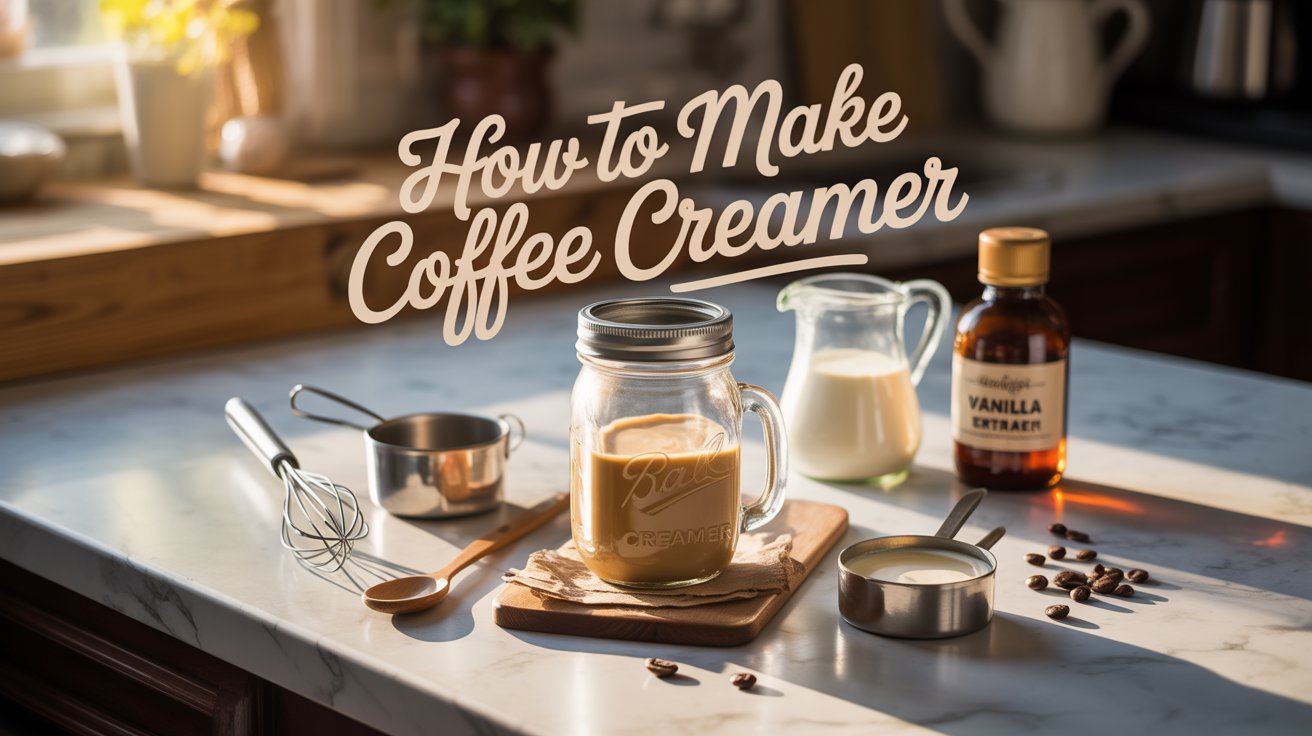
Yes — you can make your own coffee creamer at home, and it’s way easier than most people think. And if you’ve ever Googled “how to make coffee creamer”, you’re about to finally get a clear, no-nonsense answer.
Most store-bought creamers are packed with preservatives, stabilizers, and ingredients you can’t pronounce. I used them for years… until I realized I could make a fresher, cleaner, better-tasting version in under 5 minutes — with stuff already in my kitchen.
This guide shows you exactly how.
No fluff. No vague “just mix things together” advice.
You’ll get simple ratios, step-by-step variations (dairy, non-dairy, sugar-free, keto), and the one trick that keeps your creamer from separating.
If you want a richer cup, fewer additives, and flavors that actually taste like what the label promises, you’re in the right place.
Let’s make your coffee creamer — the right way.
What Is Coffee Creamer — and Why Make It Yourself?
Picture this: you wake up, brew your coffee, pour a splash of creamer… and instantly, it transforms from bitter brown to velvety, dreamy perfection. That’s the magic of coffee creamer.
But here’s the twist — most store-bought creamers are packed with preservatives, stabilizers, and flavors you didn’t even know existed.
Now imagine making it yourself: total control over taste, sweetness, and texture. Dairy, vegan, sugar-free, or seasonal spice — your coffee, your rules.
What “Creamer” Means — Milk vs. Cream vs. True “Creamer”
Coffee creamer isn’t just milk.
And it isn’t just heavy cream.
A true coffee creamer blends three components: a liquid base (dairy or non-dairy), a sweetener, and a flavor element. That’s why products labeled “creamer” behave differently in coffee than plain milk or cream. They contain stabilizers that prevent curdling and emulsifiers that keep the mixture silky even in hot espresso.
When you make it yourself, you mimic the same structure—minus industrial additives like dipotassium phosphate, gellan gum, or carrageenan found in many commercial brands. The result is a cleaner, more customizable liquid designed specifically to enrich aroma, sweetness, and mouthfeel in beverages ranging from drip coffee to cold brew.
Pros of Homemade Creamer
Homemade creamer gives you control.
Not theoretical control — practical, in-your-kitchen, every-morning control.
You control:
Ingredients. Choose dairy, almond milk, oat milk, coconut milk, or even half-and-half.
Sweetness. Use cane sugar, maple syrup, honey, erythritol, or go unsweetened entirely.
Flavors. Vanilla extract, cocoa powder, cinnamon, pumpkin spice, hazelnut extract — anything you love.
Clean label quality. No preservatives, no artificial stabilizers, no shelf-extender chemicals.
Cost savings. A homemade batch often costs less than a single bottle of premium commercial creamer from brands like International Delight or Coffee-mate.
Dietary fit. Vegan, keto, low-sugar, paleo, lactose-free, Whole-30 adjacent — you pick.
Making your own creamer also creates flavor depth you rarely taste in packaged products because you can use real vanilla, real spices, and real cream.
Common Drawbacks or Trade-Offs
Homemade does have trade-offs, and acknowledging them builds trust.
Shorter shelf life. Most batches last 5–10 days depending on the base.
Refrigeration required. No shelf-stable packaging tech like ultra-high-temperature processing.
Possible separation. Natural ingredients don’t always emulsify without additives. A quick shake fixes it.
Texture variation. Plant milks behave differently; coconut milk gives richness, oat milk gives smoothness, almond milk may be thinner.
These drawbacks are manageable — and worth the payoff if you want real ingredients in your cup.
Base Recipes — Dairy, Non-Dairy & Easy Starter Versions
Think you need fancy ingredients to make perfect coffee creamer? Think again.
From creamy dairy to plant-based wonders, these base recipes are your launchpad. Simple, flexible, and ready to transform your morning cup.
Classic Dairy Creamer Base
Best for: People who want a rich, silky texture similar to half-and-half or café-style flavored creamers.
Ingredients
1 cup milk (whole or 2%)
1 cup heavy cream or half-and-half
2–4 tablespoons sugar or sweetener
1 teaspoon vanilla extract (optional)
Instructions
Heat milk and cream gently over low heat.
Stir until sugar dissolves fully.
Remove from heat and add vanilla.
Cool completely and store in an airtight jar.
Prep Time: 5 minutes
Yield: ~2 cups
Sweetened Condensed Milk Creamer
Best for: Thick, sweet creamers that mimic classic commercial-style flavor intensity.
Ingredients
1 can (14 oz) sweetened condensed milk
1½ cups milk (any type)
1 teaspoon flavor extract (vanilla, almond, hazelnut)
Instructions
Whisk the condensed milk and regular milk until fully combined.
Add extract and stir again.
Refrigerate and shake before each use.
Prep Time: 3 minutes
Yield: ~2 cups
This version delivers consistent texture because condensed milk acts as a natural emulsifier.
Non-Dairy / Vegan Creamer Base
Best for: Dairy-free, lactose-intolerant, plant-based, or vegan lifestyles.
Ingredients
2 cups almond milk, oat milk, soy milk, or coconut milk
2–3 tablespoons maple syrup or sugar
1 teaspoon vanilla or another extract
Optional: 1 tablespoon coconut cream for extra richness
Instructions
Warm the milk slightly — just enough to dissolve the sweetener.
Stir in the syrup and extract.
Add coconut cream for thickness (optional).
Chill and shake before using.
Prep Time: 5 minutes
Yield: ~2 cups
Oat milk produces the smoothest texture; coconut adds richness similar to heavy cream.
Sugar-Free / Low-Sugar / Keto-Friendly Creamer
Best for: Keto, diabetic-friendly, or low-carb diets.
Ingredients
1 cup heavy cream
1 cup unsweetened almond milk or coconut milk
1–2 tablespoons erythritol, monk fruit, or allulose
½ teaspoon vanilla or almond extract
Instructions
Heat the mixture gently just until the sweetener dissolves.
Remove from heat and stir in flavoring.
Cool completely and store in the fridge.
Prep Time: 5 minutes
Yield: ~2 cups
Allulose dissolves most easily and avoids the “cooling effect” some keto sweeteners produce.
Flavor Variations & Customizations — From Vanilla to Seasonal Favorites
Boring coffee? Not on our watch.
From classic vanilla to pumpkin spice and mocha magic, these flavor hacks turn any cup into a café-worthy experience. Customize, experiment, and make every sip unforgettable.
Experience & Depth
After testing dozens of versions in my own kitchen — from French vanilla to chai — one thing became obvious: great flavor comes down to balance. The right extract, the right fat content, and just enough sweetness to lift the cup without overpowering it.
Classic Vanilla / French Vanilla
Vanilla is the most requested flavor because it works with every roast — from light Ethiopian to dark Indonesian beans.
How to Make It:
Add 1–2 tsp vanilla extract per cup of base creamer.
For French vanilla, mix ½ tsp vanilla bean paste or a split Madagascar vanilla bean into the warm creamer base.
Pro Tip:
Use a gently heated base for deeper infusion. The warmth coaxes flavor from real vanilla beans more effectively than cold mixing.
Hazelnut, Almond, or Nutty Creamers (with extracts)
Nutty creamers mimic popular store-bought flavors from brands like Coffee-mate but without the artificial aftertaste.
How to Make It:
Add ½–1 tsp hazelnut, almond, or macadamia extract.
Blend with dairy or oat milk for a smoother nut-forward finish.
Pro Tip:
Nut extracts can get overpowering fast. Start small and adjust after tasting.
Chocolate / Mocha / Cocoa Creamer
When you want a café-style mocha without the coffee-shop price tag, a chocolate creamer delivers.
How to Make It:
Whisk 1–2 tbsp cocoa powder with 1 tbsp hot water to make a slurry.
Mix into your warm base.
Optional: add ½ tsp espresso powder for mocha depth.
Pro Tip:
Unsweetened cocoa powder dissolves best when warmed, not cold-mixed.
Seasonal & Spiced Creamers (Pumpkin Spice, Cinnamon, Chai, Holiday Blends)
Seasonal flavors turn your morning cup into a holiday ritual.
Pumpkin Spice:
Add ½–1 tsp pumpkin spice + 2 tbsp pumpkin purée (optional for texture).
Cinnamon:
Mix ½ tsp Saigon cinnamon into a warm base for instant aroma.
Chai:
Combine ¼ tsp cardamom, ¼ tsp cinnamon, and pinch of ginger + clove.
Holiday Blend:
Use nutmeg, cinnamon, vanilla, and a tiny pinch of allspice.
Pro Tip:
Whole spices infused over low heat add complexity that extracts never achieve.
How to Adjust Sweetness, Richness & Texture
You control everything — which is the biggest advantage homemade creamer has over commercial brands.
Tweak sweetness:
Increase or decrease sugar, maple syrup, or sweetened condensed milk.
For sugar-free: use erythritol, allulose, or monk fruit.
Boost richness:
Add more heavy cream, half-and-half, or coconut cream.
Perfect texture:
Blend for 5–10 seconds for a smoother mouthfeel.
Shake vigorously if using plant-based milks with naturally lower fat content.
How to Make — Step-by-Step Instructions & Best Practices
Follow these step-by-step instructions and pro tips to make coffee creamer like a barista — smooth, creamy, and perfectly balanced every time.
Experience & Depth
After hundreds of batches, two things became clear:
You rarely need heat.
When you do use it, low-and-slow saves you from curdling.
Step-by-Step Instructions (Cold-Mix, Gently Heated, Blended)
Cold-Mix Method (fastest)
Best for: vanilla, hazelnut, almond, sugar-free.
Add ingredients to a jar.
Seal tightly.
Shake 20–30 seconds.
Chill for 2 hours.
Why it works: Extracts dissolve without heat, and dairy stays stable.
Gently Heated Method (best flavor infusion)
Best for: chai, cinnamon, pumpkin spice, chocolate.
Combine ingredients in a saucepan.
Warm on low heat (never above 160°F / 70°C).
Stir until dissolved.
Cool fully before refrigerating.
Why it works: Heating unlocks flavor from spices and cocoa but risks curdling if too hot.
Blended Method (smoothest texture)
Best for: plant-based, coconut cream, cocoa-heavy mixes.
Add ingredients to a blender.
Blend 5–10 seconds.
Chill.
Why it works: Blending emulsifies ingredients naturally without gums or stabilizers.
When to Heat (and Why) vs When Cold-Mix Works
Heat when:
You use cocoa powder, pumpkin spice, or whole spices.
You want deeper flavor infusion.
Cold-mix when:
You use extracts (vanilla, almond, hazelnut).
You want the creamer ready in minutes.
You want to avoid the risk of overheating dairy.
Risk of overheating:
Curdling at high heat.
Separation in the fridge.
Loss of subtle flavors like vanilla.
Low heat keeps everything stable — something recipe developers and food brands follow religiously.
Storage & Shelf-Life Guidelines
Real, fresh ingredients mean a shorter shelf life than commercial creamers. That’s the trade-off.
Dairy-Based Creamers:
Refrigerate immediately.
Store in airtight glass jars.
Use within 7–10 days.
Plant-Based Creamers:
Use within 5–7 days.
Shake often due to natural separation.
Sugar-Free Versions:
Last slightly less due to lower sugar content (a natural preservative).
Pro Tip:
Label your container with the prep date. It’s a habit used by home cooks and creators like Masala Monk and Roaffee to keep batches fresh and consistent.
Shake or Stir Before Each Use
Homemade creamers separate because they don’t use commercial emulsifiers like gellan gum or mono- and diglycerides.
How to reduce separation:
Shake before each use.
Blend once during the week to re-emulsify.
Add ½–1 tsp maple syrup as a natural binder if needed.
Pros & Cons — Homemade vs Store-Bought Creamer
You want to know whether homemade creamer is actually better than the bottle sitting on a grocery shelf. This section breaks down the real trade-offs so you can decide confidently.
Experience & Depth
After years of testing batches in my own kitchen — and comparing them to popular brands like Coffee-mate, International Delight, Starbucks, and Land O’Lakes creamers — I realized something simple: homemade wins on taste and purity, but store-bought still wins on convenience.
Benefits of Homemade Creamer
You control everything — flavor, sweetness, richness, and ingredients.
Key advantages:
Taste control: You shape the flavor with real vanilla, spices, cocoa, or your preferred extracts.
Fewer additives: No gums, stabilizers, hydrogenated oils, or artificial flavors.
Cost savings: Bulk ingredients cost far less per cup than buying multiple bottles.
Customization: Build sugar-free, keto, dairy-free, high-fat, or low-fat versions.
Dietary adaptability: Works for gluten-free, vegan, paleo, Whole30-style, or lactose-sensitive drinkers.
Homemade creamer fits into your lifestyle instead of the other way around.
Limitations of Homemade Creamer
The downsides are small but worth noting.
Shorter shelf-life: Real dairy lasts 7–10 days; plant-based lasts 5–7 days.
Possible separation: Without emulsifiers like gellan gum, shaking becomes part of the routine.
Less convenient: You spend a few minutes prepping instead of grabbing a bottle.
Refrigeration required: No room-temperature stability like ultra-pasteurized store brands.
If you’re used to long-lasting bottles, homemade requires a minor mindset shift.
When Store-Bought Still Makes Sense
Store-bought wins when you prioritize ease over control.
Long shelf-life: Ultra-pasteurized products stay stable for weeks.
Travel-friendly: Single-serve creamers work for trips, hotels, and offices.
Predictable flavor: Every bottle tastes identical — no guesswork.
Convenience: Zero prep, zero cleanup, zero experimentation required.
If you drink coffee irregularly or prefer grab-and-go routines, store-bought serves your lifestyle better.
Common Mistakes & How to Avoid Them
You want a foolproof creamer that doesn’t curdle, separate, spoil, or turn gritty. These are the exact mistakes beginners make — and how to fix them fast.
Experience & Depth
These mistakes are based on hundreds of batches tested at home and lessons shared by home-cooking creators like Homemade Food Junkie, who often emphasize temperature control and clean storage.
Over-Heating or Boiling (Curdling / Grainy Texture)
High heat breaks dairy proteins and causes instant curdling.
Fix:
Keep the temperature below 160°F (70°C). Warm slowly on low heat. Remove from heat the moment the mixture steams.
Not Dissolving Sugar Fully (Gritty or Lumpy Texture)
Sugar that isn’t fully dissolved settles at the bottom or forms crystals.
Fix:
Dissolve sugar in a tablespoon of hot water first, or warm the mixture gently to help it melt evenly.
Using the Wrong Ratios
Too much cream turns the mixture overly thick. Too much sugar makes it syrupy or overly sweet.
Fix:
Start with a 1:1 ratio of milk to cream (or milk to condensed milk). Adjust only after tasting.
Poor Storage Hygiene
Bacteria, mold, and rapid spoilage happen when containers aren’t clean or airtight.
Fix:
Use sterilized glass jars with tight lids. Store in the coldest part of the fridge. Label the prep date.
Troubleshooting Table
| Problem | Likely Cause | Fix |
|---|---|---|
| Curdled texture | Overheated / boiled | Keep below 160°F; heat slowly |
| Gritty sweetness | Sugar not dissolved | Pre-dissolve sugar or warm the mix |
| Too thick | Too much cream | Add milk to thin it |
| Too thin | Too much milk | Add cream or condensed milk |
| Bitter spices | Over-infused spices | Reduce heat + steep time |
| Separation in fridge | No emulsifiers | Shake before use; blend once mid-week |
| Spoils quickly | Warm fridge or unclean jar | Refrigerate immediately; sanitize container |
Health, Dietary & Nutrition Considerations
Your coffee, your rules — and your health matters.
From dairy to vegan, sugar-free to keto, these tips help you enjoy creamy coffee without compromising your diet or lifestyle.
Experience & Depth
After testing dozens of dairy and plant-based options — from oat milk blends to coconut cream, almond milk, and traditional half-and-half — I learned that the “best” creamer depends on your body, goals, and tolerance. Homemade versions let you fine-tune macros without relying on labels from brands like Coffee-mate, Califia Farms, Silk, or Elmhurst.
Dairy vs Non-Dairy: Who Each Works Best For
Dairy-Based Creamers
Great for:
People who tolerate lactose well
Fans of rich, silky textures
Coffee drinkers who want classic café-style body
Dairy brings natural fats and proteins that create a velvety mouthfeel — something plant milks often struggle to replicate without stabilizers.
Non-Dairy / Plant-Based Creamers
Great for:
Lactose-intolerant drinkers
Vegans or plant-based diets
Those avoiding dairy for digestive or skin-related reasons
Oat milk gives creaminess.
Coconut cream adds richness.
Almond milk keeps calories low.
Soy milk adds protein and stability.
Plant-based creamers shine when you want lighter digestion and simpler ingredient lists.
Sugar, Calorie & Macro Breakdown (Example Tables)
Searchers often want the numbers — especially keto, calorie-conscious, or low-sugar drinkers. Here are approximate nutrition snapshots for a 1–2 tbsp serving.
Classic Dairy Creamer (with Sugar)
| Nutrient | Approx. Amount |
|---|---|
| Calories | 45–60 |
| Fat | 2–3g |
| Carbs | 5–7g (mostly sugar) |
| Protein | 0–1g |
Sugar-Free Dairy or Keto Version
| Nutrient | Approx. Amount |
|---|---|
| Calories | 30–45 |
| Fat | 3–5g |
| Carbs | <1g |
| Protein | 0–1g |
Plant-Based Creamer (Oat, Almond, Coconut)
| Nutrient | Approx. Amount |
|---|---|
| Calories | 20–40 |
| Fat | 1–3g |
| Carbs | 2–5g |
| Protein | 0–1g |
Plant-based versions vary widely because oat milk contains natural starches, while almond milk is naturally low-calorie.
Additives & Preservatives — Why Homemade Avoids Them
Most commercial creamers rely on:
Gums: gellan gum, guar gum, carrageenan
Stabilizers: dipotassium phosphate
Hydrogenated oils: found in many non-dairy creamers
Artificial flavors & colors
These improve shelf-life, body, and emulsification.
Homemade creamer avoids all of that.
You use real milk, real flavors, real spices.
Just avoid:
Overusing artificial syrups
Adding too much sweetener
Mixing conflicting plant milks (can separate quickly)
With homemade, purity becomes a built-in feature.
Use Cases & When to Use Which Version
You want to pick the right creamer for your lifestyle — not just your recipe. These use cases help you match the creamer to the drinker.
Experience & Depth
After experimenting with dairy-heavy blends, keto-friendly creams, and dozens of seasonal variations, I learned that different people genuinely need different bases. There is no “best” — only what works best for you.
Everyday Coffee Drinker
Choose: Standard dairy or half-and-half creamer
Why it works:
Reliable texture
Balanced richness
Easy to make in batches
Pairs well with medium or dark roast coffee
Great for people who drink coffee daily and want a straightforward, consistent experience.
Dietary-Conscious Drinker
Choose:
Vegan or non-dairy bases (oat milk, coconut milk, soy milk, almond milk)
Sugar-free / low-sugar versions for calorie control
Keto-friendly versions with heavy cream + sugar substitutes
Why it works:
Flexible macros
Lower sugars
Easier digestion
Works with diets like keto, paleo, vegan, or Whole30-style (depending on ingredients)
Flavor-Lover / Seasonal Coffee Fan
Choose:
Pumpkin spice
Chai-inspired blends
Chocolate or mocha
Holiday cinnamon-maple or peppermint creamers
Why it works:
More personality
Café-style experience at home
Perfect for holiday drinks, lattes, and flavored pour-overs
Seasonal creamers let you recreate your favorite festive drinks without paying coffee-shop premiums.
Budget-Conscious & Sustainability-Minded Drinker
Choose: Homemade in bulk
Why it works:
Cheaper per serving
Less packaging waste
Avoids buying multiple disposable plastic bottles
Saves money while reducing your environmental footprint
If you drink coffee daily or brew for a family, homemade creamer becomes dramatically more economical.
FAQ
How long does homemade coffee creamer last in the fridge?
Homemade creamer — whether dairy or plant-based — generally stays good for about 7–10 days when stored in a sealed, airtight container.
Can I make dairy-free or vegan coffee creamer?
Absolutely. Use non-dairy milks like oat, almond, coconut, or soy instead of dairy. Many home brewers do this to suit lactose intolerance, vegan diets, or lighter dietary preferences.
Why does my homemade creamer separate in the fridge?
Natural homemade creamers lack the stabilizers or emulsifiers found in commercial products, so separation is normal. A good shake or quick stir before each use re-mixes everything.
Can I make coffee creamer without sugar or with low sugar?
Yes — you can skip sugar or use alternatives like monk fruit, stevia, or allulose. A sugar-free creamer version reduces carbs and calories and still delivers a creamy texture.
Is homemade creamer cheaper than store-bought?
Usually yes. When you calculate ingredient cost per serving — milk, cream (or plant milk), sweetener, and flavor — homemade creamer typically costs far less than repeatedly buying pre-made bottles. Many regulars say DIY saves noticeable money over time. (Based on common home-cooking cost comparisons.)
Do I need to heat the mixture when making creamer?
Not always. If you’re using simple liquid bases and flavor extracts, mixing cold and shaking is often enough. Heat only when dissolving cocoa, infusing spices, or adding ingredients like condensed or coconut milk for better integration.
Final Thoughts
You now know exactly how to make coffee creamer that tastes better, costs less, and fits your diet without the additives you don’t want. Simple ingredients. Zero mystery. Total control.
Start with the base that fits your lifestyle, tweak the sweetness, and build flavors that feel like you. Once you make your first batch, you’ll wonder why you ever reached for store-bought.
Try your first homemade batch today. Your morning coffee will never be “just coffee” again.

Shahriar brings a unique blend of storytelling prowess and digital expertise to Daily Coffee Guide. With a background in SEO and content strategy, he ensures our articles on Beans, Coffee, Tea, and Drinks are both engaging and discoverable. His passion for coffee culture drives him to explore and share the rich narratives behind every cup.